

About NAD+
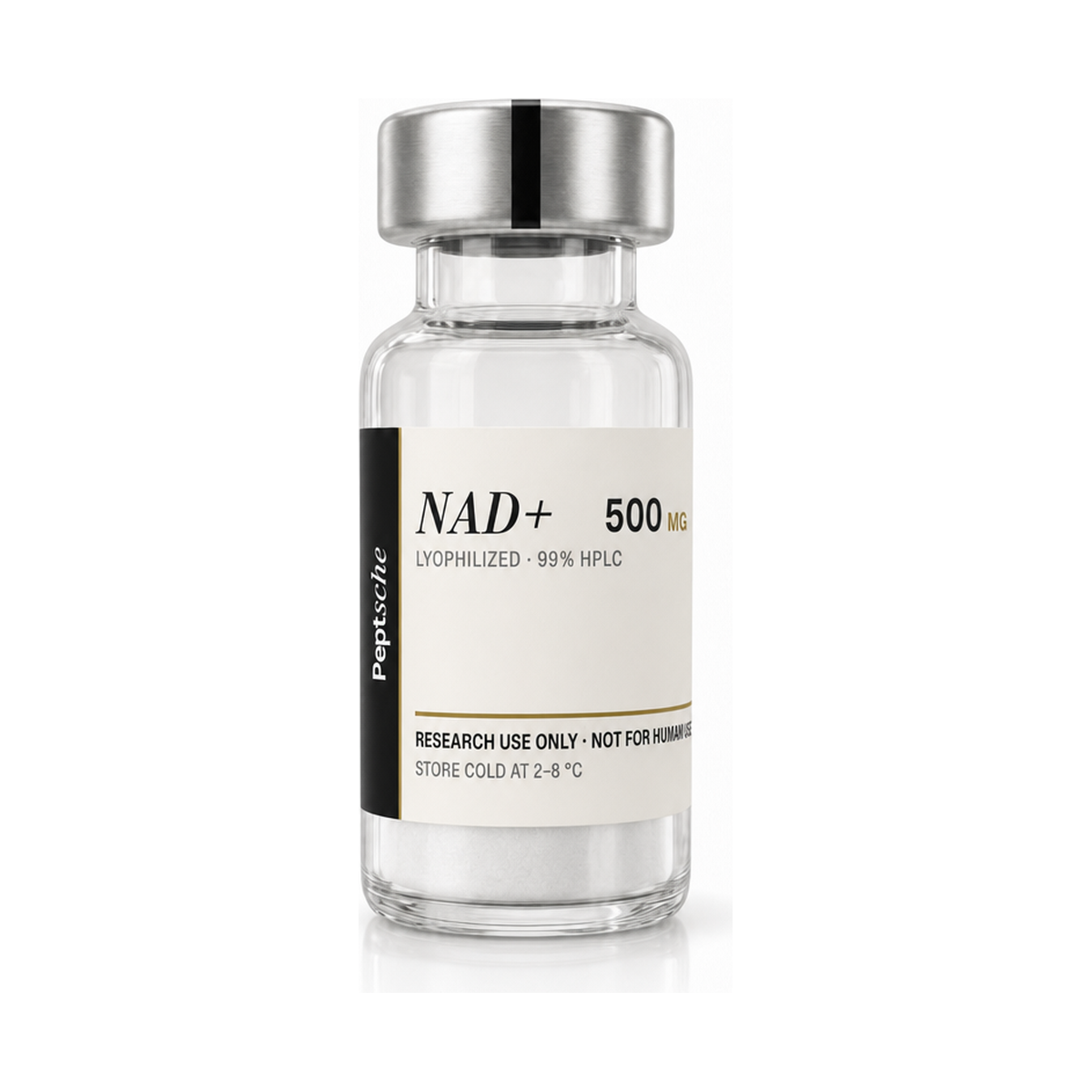
NAD+ is nicotinamide adenine dinucleotide, a dinucleotide coenzyme with the molecular formula C21H27N7O14P2 and a molecular weight of 663.4 g/mol. Unlike the peptides that make up most of this catalog it is not a synthetic amino acid chain but an endogenous coenzyme found in all living cells, formed from a nicotinamide mononucleotide joined to an adenine nucleotide by a pyrophosphate bridge. Peptsche supplies it as a lyophilized powder sealed in a single use glass vial. In the published literature NAD+ is studied as a redox cofactor, as a substrate for sirtuin and PARP enzymes and as a variable in cellular ageing and mitochondrial research. Peptsche supplies NAD+ strictly as a research material for controlled laboratory investigation.
Available Sizes
This listing covers one vial configuration. Every lot is assayed before release, so the stated purity applies to the batch shipped.
- 500mg vial of lyophilized NAD+, 99% or greater purity by HPLC
Product Specifications
| Product | NAD+ (nicotinamide adenine dinucleotide) |
| Application | Research use only. Laboratory and in vitro investigation. |
| Appearance | White to off white lyophilized powder |
| Chemical Formula | C21H27N7O14P2 |
| Molecular Weight | 663.4 g/mol |
| CAS Number | 53-84-9 |
| PubChem CID | 5892 |
| Synonyms | nadide, beta-NAD, coenzyme I, diphosphopyridine nucleotide |
| Purity | 99% or greater by HPLC, verified per batch |
| Storage | Store sealed at 2 to 8 °C, protected from heat, light and moisture |
| Regulatory Status | Research use compound. No approved drug product exists under the name nadide. Not approved for human or veterinary use. |
What is NAD+?
Chemically, NAD+ is a dinucleotide: two nucleotides linked through their phosphate groups. One carries adenine, the other nicotinamide, and the pyridine ring of the nicotinamide moiety is the reactive centre. The plus sign denotes the positive charge on that ring in the oxidised state, distinguishing it from the reduced counterpart NADH. Because it is a nucleotide rather than a peptide, its analytical profile, solubility and stability characteristics differ from the amino acid based compounds in this catalog.
Interest in the molecule is old by the standards of biochemistry. It was identified in yeast extracts in the early twentieth century as a heat stable factor required for fermentation and later characterised as coenzyme I, a name that survives among its synonyms. Its role in oxidation and reduction reactions was established by mid century. A second phase opened when Imai, Guarente, Verdin and others linked the endogenous pool to sirtuin enzymes, which consume it as a substrate rather than cycling it.
The literature cited concerns the biology of the endogenous coenzyme within cells: how pools are synthesised, consumed and depleted, and how they relate to metabolic and ageing processes in the systems studied. That work is not a study of any administered product. NAD+ has no approved drug product under the name nadide and is not approved for human or veterinary use, and no conclusion about humans should be drawn from the cell biology record.
NAD+ Mechanism of Action (Research Only)
Mechanistic accounts describe the role of the endogenous coenzyme in cellular biochemistry. The summaries below report observations about cellular NAD+ biology, not effects of any administered material in humans.
Redox Cofactor Role in Metabolism
The best established role is as an electron carrier. It accepts a hydride ion at the nicotinamide ring to become NADH and releases it on reoxidation, cycling between the two states without net consumption. Hundreds of dehydrogenases across glycolysis, the tricarboxylic acid cycle and fatty acid oxidation depend on this couple, and the ratio of oxidised to reduced forms is used as an indicator of metabolic state.
Substrate for Sirtuins and PARP Enzymes
A separate class of reactions consumes rather than cycles the coenzyme. Sirtuin deacetylases cleave it to transfer an acetyl group and release nicotinamide, and poly ADP ribose polymerases consume it while building polymers during DNA damage responses. Because these enzymes deplete the pool, cellular concentration becomes a regulated variable, and Imai and Guarente described this coupling between availability and enzyme activity.
Mitochondrial Function and Cellular Ageing Research
Covarrubias, Verdin and colleagues reviewed measurements showing that cellular pools change with age in the model systems examined and connected those changes to mitochondrial performance. This work uses the endogenous pool as a readout in ageing research, and the findings are observations within cell and animal models.
Integrated Mechanistic Profile
The literature describes cellular NAD+ biology through three connected themes.
- Redox cycling. An electron carrier shared by dehydrogenases across central metabolism, interconverting with NADH.
- Enzymatic consumption. A substrate depleted by sirtuins and PARP enzymes, making the cellular pool a regulated quantity.
- Ageing and mitochondrial research. Reported changes in pool size with age in the model systems examined.
Note: NAD+ is supplied strictly for research use only. It is intended as an experimental compound for qualified laboratory personnel and is not a drug, food or cosmetic.
NAD+ is supplied exclusively for laboratory research use and is not intended for human or veterinary application.
Research Applications (Observations from Studies)
The areas below describe how NAD+ is used as a laboratory reagent and what the cited literature reports.
Enzyme Assays and Biochemical Reagent Use
The most common application is as a defined cofactor in enzyme assays. Dehydrogenase activity is followed by monitoring absorbance at 340 nanometres as the coenzyme cycles between forms, and sirtuin and PARP assays require it as a substrate.
Cellular Metabolism and Mitochondrial Studies
In cultured cells and isolated mitochondria the ratio of oxidised to reduced coenzyme indicates metabolic state. Researchers examine how the ratio shifts with substrate availability, respiratory chain inhibition and manipulation of the enzymes that synthesise or consume it.
Ageing Biology and Analytical Standards
The reviews cited below summarise measurements of endogenous pools in tissues and cells across age. Separately, high purity material serves as an analytical standard for methods quantifying the coenzyme and its metabolites in biological samples.
NAD+ is supplied exclusively for laboratory research use and is not intended for human or veterinary application.
NAD+ Compared With Related Research Compounds
The table below places NAD+ alongside two related compounds in the Peptsche range. It is offered to clarify differences in classification, molecular target and research context. It should not be read as a comparison of clinical performance, safety, or suitability for any application.
| Characteristic | NAD+ | 5-Amino-1MQ | Epitalon |
| Research Classification | Endogenous dinucleotide coenzyme found in all living cells, not a synthetic peptide | Small molecule quaternary methylquinolinium enzyme inhibitor, not a peptide and with no amino acid sequence | Synthetic tetrapeptide of standard amino acids, residue sequence Ala Glu Asp Gly |
| Primary Molecular Target | Dehydrogenase enzymes as a redox couple, and sirtuin and PARP enzymes as a consumed substrate | Nicotinamide N methyltransferase, an enzyme rather than a receptor | No defined receptor target. Examined in relation to telomerase and telomere length in human cell lines |
| Mechanistic Profile | Cycles between oxidised and reduced states as an electron carrier and is cleaved as a substrate by sirtuins and poly ADP ribose polymerases | Inhibition of a methyltransferase, studied for its position in nicotinamide adenine dinucleotide salvage metabolism rather than for receptor pharmacology | Reported telomerase related activity in cell culture, with pineal and circadian signalling as the original research context |
| Primary Research Focus | Enzyme assays and biochemical reagent use, cellular metabolism and mitochondrial studies, ageing biology and analytical standards | Enzyme inhibition studies, preclinical metabolic model systems, analytical method development | Cell line telomere studies, gerontology model systems, short peptide stability and handling |
| Structural Design | A nicotinamide mononucleotide joined to an adenine nucleotide by a pyrophosphate bridge, no amino acid residues | Quinoline ring carrying a methylated ring nitrogen with a permanent positive charge and an amino group at position 5, supplied with a counter ion | Four residues with two acidic side chains and no secondary structure, highly water soluble |
| Regulatory Status | Research use compound. No approved drug product exists under the name nadide, and it is not approved for human or veterinary use | Research use compound, not approved for human or veterinary use in any jurisdiction, and absent from the United States Food and Drug Administration bulk drug substances list, an absence that is not any form of approval | Research use compound, not approved for human or veterinary use in any jurisdiction, and appearing among the bulk drug substances withdrawn from consideration for compounding by the United States Food and Drug Administration |
NAD+ is supplied exclusively for laboratory research use and is not intended for human or veterinary application.
Laboratory Handling and Storage Considerations
Lyophilized NAD+ should be stored sealed at 2 to 8 °C, protected from heat, light and moisture. The powder is hygroscopic, so vials should reach ambient temperature before opening. The molecule is unstable in alkaline conditions and degrades faster in warm aqueous solution than in the dry state, so buffer selection and working temperature matter. Prepared solutions should be aliquoted rather than cycled repeatedly through freezing and thawing, and each container should carry compound identity, lot number and preparation date.
Laboratory Safety Considerations
The practices below apply to routine handling in a research setting.
- Personal protective equipment: Wear nitrile gloves, a laboratory coat and side shield safety glasses whenever a vial is open.
- Engineering controls: Weigh and prepare solutions in a certified fume hood to limit dispersal of the fine powder.
- Exposure prevention: Avoid skin, eye and mucous membrane contact, keep food out of the working area and wash hands afterwards.
- Storage: Keep sealed vials at 2 to 8 °C in a dedicated research chemical location, separated from consumer products.
- Spill response: Collect spilled powder without raising dust, decontaminate the surface and treat the residue as chemical waste.
- Disposal: Discard unused material, solutions and contaminated consumables through the institutional chemical waste stream.
- Documentation: Record lot number, receipt date, storage conditions and each preparation so that results stay traceable to a batch.
Certificate of Analysis and Quality Assurance
Every production lot of NAD+ supplied by Peptsche undergoes analytical evaluation, and a batch specific Certificate of Analysis accompanies each order to support research documentation, quality control and experimental consistency.
Each Certificate of Analysis typically includes:
- Identity verification using analytical techniques such as mass spectrometry to confirm the molecular characteristics of the material supplied.
- Purity analysis performed by high performance liquid chromatography to quantify purity and identify potential impurities.
- Batch documentation recording lot number, testing date, analytical methods applied and quality assessment results.
- Traceability information to support laboratory recordkeeping and reproducibility across research workflows.
Peptsche works with Janoshik Analytical, an independent testing laboratory, for third party verification of research material quality. Independent testing provides transparency and confidence in product identity, consistency and sourcing, and batch specific documentation can be retained as part of laboratory records and internal quality procedures.
NAD+ is supplied exclusively for laboratory research use and is not intended for human or veterinary application.
Frequently Asked Questions
What is NAD+?
NAD+ is nicotinamide adenine dinucleotide, an endogenous dinucleotide coenzyme found in all living cells rather than a synthetic amino acid chain. It is formed from a nicotinamide mononucleotide joined to an adenine nucleotide by a pyrophosphate bridge and has a molecular weight of 663.4 g/mol. Peptsche supplies it as a lyophilized powder sealed in a single use glass vial for controlled laboratory investigation.
What is NAD+ studied for in research?
Published work studies it as a redox cofactor, as a substrate for sirtuin and PARP enzymes, and as a variable in cellular ageing and mitochondrial research. High purity material also serves as a defined cofactor in enzyme assays and as an analytical standard for methods quantifying the coenzyme and its metabolites in biological samples. That literature concerns the biology of the endogenous coenzyme within cells and is not a study of any administered product.
How does NAD+ work in laboratory research?
In the systems described in the literature it accepts a hydride ion at the nicotinamide ring to become NADH and releases it on reoxidation, cycling between the two states without net consumption, which is why the ratio of oxidised to reduced forms is used as an indicator of metabolic state. A separate class of reactions consumes rather than cycles it: sirtuin deacetylases cleave it to transfer an acetyl group and release nicotinamide, and poly ADP ribose polymerases consume it while building polymers during DNA damage responses. Because those enzymes deplete the pool, cellular concentration becomes a regulated variable.
How is the quality of Peptsche NAD+ verified?
Every production lot of Peptsche NAD+ is evaluated analytically, with identity confirmed using techniques such as mass spectrometry and purity quantified by high performance liquid chromatography against the stated specification of 99% or greater. Peptsche works with Janoshik Analytical, an independent testing laboratory, for third party verification, and a batch specific Certificate of Analysis accompanies each order.
How should unopened NAD+ be stored?
Unopened vials should be stored sealed at 2 to 8 °C, protected from heat, light and moisture. Vials should reach ambient temperature before opening so condensation does not form on the cold powder. Lot number, receipt date and storage conditions should be recorded in laboratory documentation so results stay traceable to a batch.
Is NAD+ intended for human use?
No. NAD+ is supplied strictly for laboratory research use only. It is not approved for human consumption, veterinary use, diagnosis, treatment or any medical application.
Why do researchers choose Peptsche for NAD+?
Peptsche supplies NAD+ at 99% or greater purity by HPLC, verified per batch, as a lyophilized powder sealed in a single use glass vial. Purity matters for a compound used as a defined cofactor and analytical standard, so every lot is released against batch specific analytical documentation, and independent third party confirmatory analysis supports reproducibility across research workflows.
Scientific References
- Covarrubias AJ, Perrone R, Grozio A, Verdin E. NAD+ metabolism and its roles in cellular processes during ageing. Nature Reviews Molecular Cell Biology. 2021;22(2):119 to 141. https://pubmed.ncbi.nlm.nih.gov/33353981/
- Verdin E. NAD+ in aging, metabolism, and neurodegeneration. Science. 2015;350(6265):1208 to 1213. https://pubmed.ncbi.nlm.nih.gov/26785480/
- Imai S, Guarente L. NAD+ and sirtuins in aging and disease. Trends in Cell Biology. 2014;24(8):464 to 471. https://pubmed.ncbi.nlm.nih.gov/24786309/
RESEARCH USE ONLY
These compounds are NOT intended for human consumption, clinical use, or veterinary applications. We are not affiliated with any pharmaceutical companies or their commercial medications. By placing an order, you certify these materials will be used exclusively for in vitro testing and laboratory experimentation only. Bodily introduction of any kind into humans or animals is strictly forbidden by law. This product should only be handled by licensed, qualified professionals. This product is not a drug, food, or cosmetic and may not be misbranded, misused or mislabeled as a drug, food or cosmetic.