

About PT-141
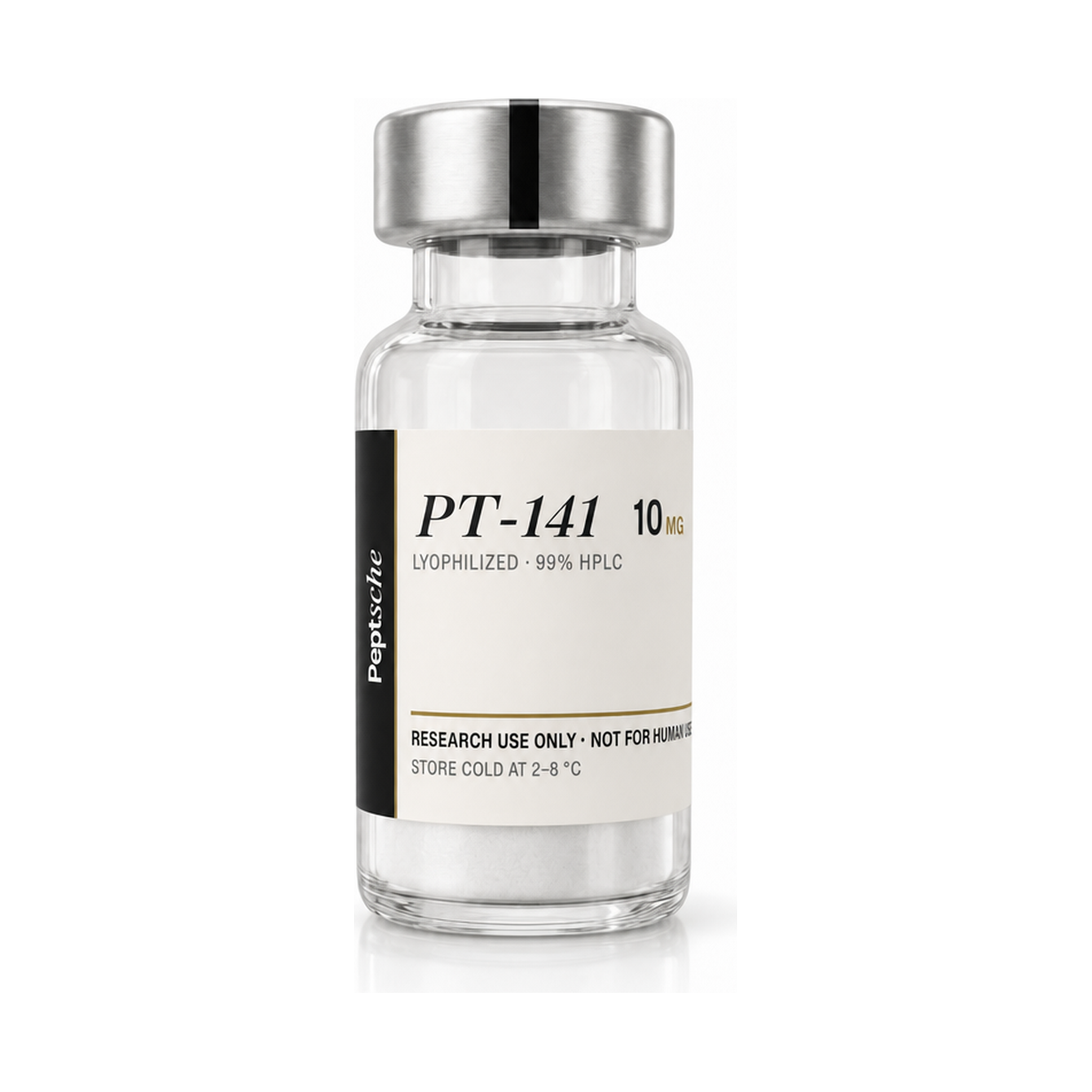
PT-141, also known as bremelanotide, is a synthetic cyclic heptapeptide of the melanocortin ligand family. Its structure is built around a lactam bridge that locks the backbone into a constrained ring, with an acetylated amino terminus. Peptsche offers it as a lyophilized powder in a sealed vial, prepared by solid phase synthesis and cyclisation and characterised by chromatography and mass spectrometry. Because the same molecule is the active ingredient of an approved prescription medicine, the distinction between that product and this laboratory reagent is set out plainly below. Peptsche supplies PT-141 strictly as a research material for controlled laboratory investigation.
Available Sizes
Offered in one vial configuration, sealed with a butyl closure and crimp.
- 10 mg lyophilized PT-141 per vial
Product Specifications
| Product | PT-141 (bremelanotide), research grade lyophilized powder |
| Application | In vitro and laboratory research use only. Not for human or veterinary use. |
| Appearance | White to off white powder |
| Chemical Formula | C50H68N14O10 |
| Molecular Weight | 1025.2 g/mol |
| CAS Number | 189691-06-3 |
| PubChem CID | 9941379 |
| Sequence | Ac Nle cyclo(Asp His D-Phe Arg Trp Lys) OH, an acetylated cyclic heptapeptide with a lactam bridge |
| Synonyms | PT-141, bremelanotide |
| Purity | 99% or greater by HPLC, verified per batch |
| Storage | Store sealed at 2 to 8 °C, protected from heat, light and moisture |
| Regulatory Status | The bremelanotide molecule is the active ingredient in an approved prescription medicine marketed as Vyleesi by Palatin Technologies, approved by the United States Food and Drug Administration in 2019. The material supplied by Peptsche is a research grade compound. It is not that approved medicine, is not manufactured to pharmaceutical standards, and is not approved for human or veterinary use. |
What is PT-141?
The melanocortin system comprises five G protein coupled receptors, MC1R through MC5R, and endogenous peptide ligands derived from proopiomelanocortin. PT-141 is a synthetic ligand for this system, developed from earlier cyclic analogue chemistry that established how a constrained ring presents the conserved recognition motif to these receptors.
The ring is closed by an amide bond between an aspartate side chain and a lysine side chain, forming a lactam. Within it sits the His Phe Arg Trp motif common to melanocortin ligands, with the phenylalanine in the D configuration, and the amino terminal norleucine is acetylated. The result is a compact, conformationally restricted and comparatively stable molecule.
The regulatory distinction should stay clear. The same molecule is manufactured under pharmaceutical controls by its developer and sold as an approved prescription product. The material offered here is a research reagent. It shares the chemical structure but not the manufacturing controls, formulation, excipients or regulatory status of that medicine, and clinical data on the medicine does not characterise this reagent.
PT-141 Mechanism of Action (Research Only)
Mechanistic interest rests on melanocortin receptor pharmacology and on how the constrained ring shapes ligand behaviour.
Melanocortin Receptor Agonism at MC3R and MC4R
PT-141 acts as an agonist at melanocortin receptors, with the activity most often examined in the literature falling on MC3R and MC4R. These class A G protein coupled receptors couple to the stimulatory G protein and raise cyclic adenosine monophosphate. In systems expressing recombinant receptors the usual readouts are cyclic nucleotide accumulation and competition binding against a labelled ligand, together defining potency and selectivity across subtypes.
Cyclic Lactam Structure and Conformational Constraint
Closing the peptide into a ring through a side chain lactam removes most of the backbone flexibility a linear peptide of the same sequence would have. The bound conformation therefore sits closer to those the free molecule already occupies, raising affinity and reducing entropic cost on binding. Constraint also limits exopeptidase access, so the cyclic molecule is more robust in serum than a linear equivalent.
Central Melanocortin Signalling as a Research Area
MC3R and MC4R are expressed in the central nervous system, and mapping where melanocortin signalling operates in neural circuits is an active field. Synthetic ligands of defined selectivity are the principal tools for that work, used in receptor autoradiography, slice preparations and genetically modified model systems to dissect which subtype mediates a given cellular response.
Integrated Mechanistic Profile
- Receptor engagement: melanocortin receptor agonism with activity at MC3R and MC4R.
- Conformational constraint: the cyclic lactam restricts backbone flexibility, raising affinity and resisting exopeptidase attack.
- Central signalling tool: a defined ligand for investigating melanocortin receptor pharmacology in the central nervous system.
Note: PT-141 is supplied strictly for research use only. It is intended as an experimental compound for qualified laboratory personnel and is not a drug, food or cosmetic.
PT-141 is supplied exclusively for laboratory research use and is not intended for human or veterinary application.
Research Applications (Observations from Studies)
The summaries below describe published work involving this molecule. They are not statements about the product offered for sale.
Clinical Studies of the Approved Medicine
The first two references below are human clinical trials of the approved pharmaceutical product, run by its developer and collaborators, and the third is a neurobiology review co authored by that developer. These publications characterise a manufactured medicine. They do not characterise research grade material and must not be read as describing the compound sold here.
Receptor Selectivity Profiling
Cyclic melanocortin ligands are used across panels of recombinant receptor lines to establish potency at each subtype. Such profiling underpins structure activity understanding of the family and gives comparators for newly synthesised analogues.
Analytical and Stability Method Development
Because the molecule is small, cyclic and highly pure, it is a convenient standard for chromatography and mass spectrometry method development, and for stability studies comparing constrained rings against linear peptides.
PT-141 is supplied exclusively for laboratory research use and is not intended for human or veterinary application.
PT-141 Compared With Related Research Compounds
The table below places PT-141 alongside two related compounds in the Peptsche range. It is offered to clarify differences in classification, molecular target and research context. It should not be read as a comparison of clinical performance, safety, or suitability for any application.
| Characteristic | PT-141 | Melanotan II | Kisspeptin-10 |
| Research Classification | Synthetic cyclic heptapeptide of the melanocortin ligand family | Synthetic cyclic lactam bridged heptapeptide of the same melanocortin family | Synthetic decapeptide, the carboxy terminal fragment of the kisspeptin precursor |
| Primary Molecular Target | Melanocortin receptors, with the activity most often examined falling on MC3R and MC4R | Melanocortin receptors, activated across several of the five subtypes | GPR54, the kisspeptin receptor, a G protein coupled receptor |
| Mechanistic Profile | Melanocortin receptor agonism, with a constrained lactam ring presenting the conserved recognition motif and reported activity concentrated on MC3R and MC4R | Agonism reported across melanocortin receptor subtypes rather than discriminating sharply between them, which is why it serves as a broad reference ligand for the family | Receptor agonism established in cell based assays, the standard agonist used to probe GPR54 |
| Primary Research Focus | Melanocortin receptor pharmacology, receptor selectivity profiling, analytical and stability method development | Structure activity work on melanocortin analogues, analogue design chemistry, central nervous system receptor studies | Receptor binding assays, gonadotropin releasing hormone regulation in animal models, bone cell signalling |
| Structural Design | Seven residues, acetylated norleucine terminus, side chain lactam bridge, D-Phe inside the ring, free acid carboxy terminus | The same ring and D-Phe arrangement, closed with an amidated carboxy terminus | Ten residues with a carboxy terminal amide required for receptor recognition |
| Regulatory Status | The bremelanotide molecule is the active ingredient in the approved medicine Vyleesi by Palatin Technologies. The material supplied is research grade, is not that medicine, and is not approved for human or veterinary use | Research use compound, not approved for human or veterinary use in any jurisdiction. It appears among the bulk drug substances withdrawn from consideration for compounding by the United States Food and Drug Administration, and regulators in Australia and Ireland have issued public safety notices | Research use compound, listed in category 2 of the United States Food and Drug Administration interim policy on bulk drug substances for compounding under section 503A, added in September 2023 |
PT-141 is supplied exclusively for laboratory research use and is not intended for human or veterinary application.
Laboratory Handling and Storage Considerations
The lyophilized powder is hygroscopic and should be handled promptly in a low humidity environment. Vials should reach ambient temperature before opening so condensation does not form on the cold cake. Sealed vials are stable at 2 to 8 °C when kept dry and dark. The tryptophan residue makes the molecule sensitive to photo oxidation, so amber glassware or foil wrapping is advisable.
In solution stability is reduced, although the cyclic backbone resists better than a linear peptide. Solutions should be sterile filtered, buffered, refrigerated, protected from light and used within a window the laboratory sets by its own testing. Aliquot into single use portions.
Laboratory Safety Considerations
- Personal protective equipment: laboratory coat, nitrile gloves and eye protection whenever the vial is open.
- Engineering controls: handle open vials inside a certified fume hood or containment enclosure.
- Exposure prevention: avoid contact with skin and eyes, do not inhale the powder, never pipette by mouth.
- Storage: keep sealed at 2 to 8 °C, protected from heat, light and moisture, in a restricted area.
- Spill response: restrict access, avoid raising dust, collect with a damp wipe, then decontaminate and seal the waste.
- Disposal: treat unused material and contaminated consumables as chemical laboratory waste under institutional rules.
- Documentation: record lot number, receipt date, storage conditions and quantities used for traceability.
Certificate of Analysis and Quality Assurance
Every production lot of PT-141 supplied by Peptsche undergoes analytical evaluation, and a batch specific Certificate of Analysis accompanies each order to support research documentation, quality control and experimental consistency.
Each Certificate of Analysis typically includes:
- Identity verification using analytical techniques such as mass spectrometry to confirm the molecular characteristics of the material supplied.
- Purity analysis performed by high performance liquid chromatography to quantify purity and identify potential impurities.
- Batch documentation recording lot number, testing date, analytical methods applied and quality assessment results.
- Traceability information to support laboratory recordkeeping and reproducibility across research workflows.
Peptsche works with Janoshik Analytical, an independent testing laboratory, for third party verification of research material quality. Independent testing provides transparency and confidence in product identity, consistency and sourcing, and batch specific documentation can be retained as part of laboratory records and internal quality procedures.
PT-141 is supplied exclusively for laboratory research use and is not intended for human or veterinary application.
Frequently Asked Questions
What is PT-141?
PT-141, also known as bremelanotide, is a synthetic cyclic heptapeptide of the melanocortin ligand family, supplied by Peptsche as a lyophilized powder in a sealed vial. The same molecule is the active ingredient in an approved prescription medicine marketed as Vyleesi by Palatin Technologies. The material supplied here is a research grade compound, is not that medicine, and is not approved for human or veterinary use.
What is PT-141 studied for in research?
Published work involving this molecule covers melanocortin receptor pharmacology, receptor selectivity profiling across panels of recombinant receptor lines, and analytical and stability method development. The first references listed on this page are clinical trials of the approved pharmaceutical product and characterise that manufactured medicine rather than research grade material. These describe laboratory and clinical study contexts rather than properties of the compound offered here.
How does PT-141 work in laboratory research?
PT-141 acts as an agonist at melanocortin receptors, with the activity most often examined in the literature falling on MC3R and MC4R. These class A G protein coupled receptors couple to the stimulatory G protein and raise cyclic adenosine monophosphate, so the usual readouts are cyclic nucleotide accumulation and competition binding against a labelled ligand. The cyclic lactam removes most of the backbone flexibility a linear peptide would have, which raises affinity and limits exopeptidase access.
How is the quality of Peptsche PT-141 verified?
Every production lot of Peptsche PT-141 is evaluated analytically, with identity confirmed using techniques such as mass spectrometry and purity quantified by high performance liquid chromatography. Peptsche works with Janoshik Analytical, an independent testing laboratory, for third party verification, and a batch specific Certificate of Analysis accompanies each order.
How should unopened PT-141 be stored?
Unopened vials should be stored sealed at 2 to 8 °C, protected from heat, light and moisture. The lyophilized powder is hygroscopic, so vials should reach ambient temperature before opening and be handled promptly in a low humidity environment. Lot number, receipt date and storage conditions should be recorded so results stay traceable to a batch.
Is PT-141 intended for human use?
No. PT-141 is supplied strictly for laboratory research use only. It is not approved for human consumption, veterinary use, diagnosis, treatment or any medical application.
Why do researchers choose Peptsche for PT-141?
Peptsche supplies PT-141 at 99% or greater purity by HPLC, verified per batch, prepared by solid phase synthesis and cyclisation and characterised by chromatography and mass spectrometry. Each vial is sealed with a butyl closure and crimp and accompanied by batch specific analytical documentation. Independent third party verification and full lot traceability support reproducibility across research workflows.
Scientific References
- Kingsberg SA, Clayton AH, Portman D, Williams LA, Krop J, Jordan R, Lucas J, Simon JA. Bremelanotide for the Treatment of Hypoactive Sexual Desire Disorder: Two Randomized Phase 3 Trials. Obstetrics and Gynecology. 2019;134(5):899 to 908. https://pubmed.ncbi.nlm.nih.gov/31599840/
- Simon JA, Kingsberg SA, Portman D, Williams LA, Krop J, Jordan R, Lucas J, Clayton AH. Long-Term Safety and Efficacy of Bremelanotide for Hypoactive Sexual Desire Disorder. Obstetrics and Gynecology. 2019;134(5):909 to 917. https://pubmed.ncbi.nlm.nih.gov/31599847/
- Pfaus JG, Sadiq A, Spana C, Clayton AH. The neurobiology of bremelanotide for the treatment of hypoactive sexual desire disorder in premenopausal women. CNS Spectrums. 2022;27(3):281 to 289. https://pubmed.ncbi.nlm.nih.gov/33455598/
RESEARCH USE ONLY
These compounds are NOT intended for human consumption, clinical use, or veterinary applications. We are not affiliated with any pharmaceutical companies or their commercial medications. By placing an order, you certify these materials will be used exclusively for in vitro testing and laboratory experimentation only. Bodily introduction of any kind into humans or animals is strictly forbidden by law. This product should only be handled by licensed, qualified professionals. This product is not a drug, food, or cosmetic and may not be misbranded, misused or mislabeled as a drug, food or cosmetic.