

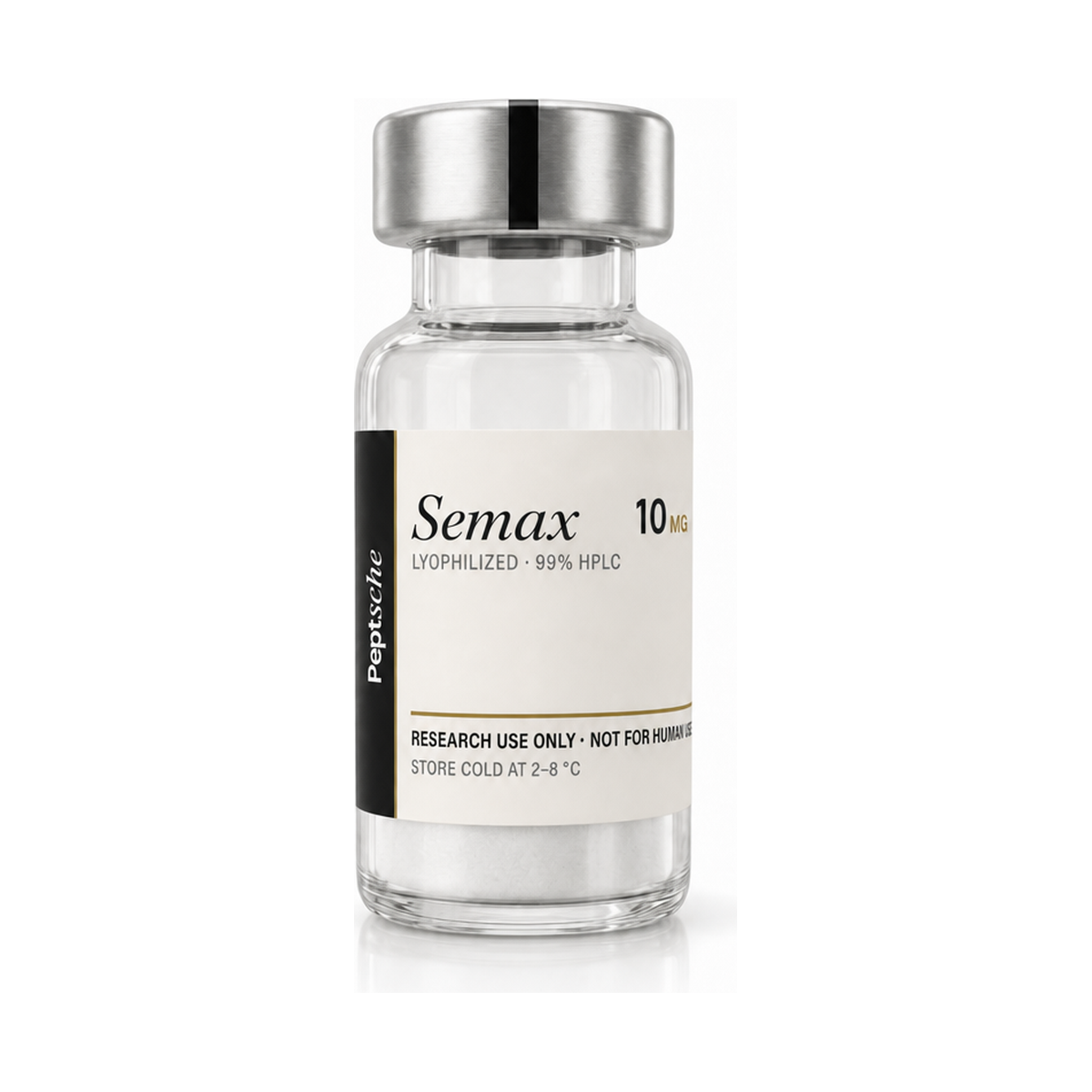
About Semax
Semax is a synthetic heptapeptide with the molecular formula C37H51N9O10S and a molecular weight of 813.9 g/mol, built from the residue sequence Met Glu His Phe Pro Gly Pro. Its structure is the adrenocorticotropic hormone fragment 4 to 7 extended at the carboxy end by Pro Gly Pro. Peptsche supplies it as a lyophilized powder sealed in a single use glass vial. In the published literature Semax has been studied in connection with neurotrophin gene expression, transcriptional profiling in rodent brain tissue and peptide stability chemistry. Peptsche supplies Semax strictly as a research material for controlled laboratory investigation.
Available Sizes
This listing covers one vial configuration. Every lot is assayed before release, so the stated purity applies to the batch shipped.
- 10mg vial of lyophilized Semax, 99% or greater purity by HPLC
Product Specifications
| Product | Semax |
| Application | Research use only. Laboratory and in vitro investigation. |
| Appearance | White to off white lyophilized powder |
| Chemical Formula | C37H51N9O10S |
| Molecular Weight | 813.9 g/mol |
| CAS Number | 80714-61-0 |
| PubChem CID | 9811102 |
| Sequence | Met Glu His Phe Pro Gly Pro (ACTH fragment 4 to 7 extended with Pro Gly Pro) |
| Synonyms | ACTH(4-7)-PGP, MEHFPGP |
| Purity | 99% or greater by HPLC, verified per batch |
| Storage | Store sealed at 2 to 8 °C, protected from heat, light and moisture |
| Regulatory Status | Research use compound. Not approved in the United States and withdrawn from consideration on the Food and Drug Administration bulk drug substances list. Not approved for human or veterinary use. |
What is Semax?
Chemically, Semax is a seven residue peptide of standard amino acids. The first four reproduce a short internal fragment of the adrenocorticotropic hormone sequence and the remaining three form a Pro Gly Pro tail at the carboxy terminus. That tail distinguishes the molecule from the parent fragment: proline rich terminal sequences are poor substrates for many exopeptidases, so the modification is described as a stability measure rather than a change to the recognition portion.
The compound originates from Russian peptide chemistry programmes of the 1980s that examined short pituitary hormone fragments separated from the activity of the full sequence. Work by Myasoedov, Dolotov, Agapova, Medvedeva and colleagues built a rodent literature around gene expression in brain tissue. Much of that work appeared in Russian language journals, so the citation record is concentrated in a small number of laboratories.
The evidence base for Semax is preclinical. Published findings come from rodent brain tissue, cultured cells and transcriptional profiling experiments. Semax is not approved in the United States, was withdrawn from consideration on the Food and Drug Administration bulk drug substances list, and is not approved for human or veterinary use in any jurisdiction.
Semax Mechanism of Action (Research Only)
Mechanistic accounts centre on gene expression in rodent brain tissue and on the structural feature distinguishing Semax from the parent fragment. The summaries below describe reported preclinical observations, not effects in humans.
BDNF and trkB Expression Regulation
Dolotov and colleagues examined brain derived neurotrophic factor and its receptor trkB in the rat hippocampus and reported changes in the expression of both in the animals studied. This anchors later mechanistic discussion, pointing to a neurotrophin signalling axis rather than a classical receptor agonist relationship. The measurements were transcript and protein levels in dissected tissue.
Neurotrophin Gene Expression
Agapova and colleagues measured neurotrophin gene expression in rat brain and reported altered transcript levels for several family members. Work of this type applies Semax as a stimulus and reads out the transcriptional response, describing which genes move rather than establishing a receptor level mechanism. Findings are observations in the brain regions and time points sampled.
The Pro Gly Pro Extension and Enzymatic Stability
The carboxy terminal Pro Gly Pro tripeptide is the feature most often discussed in chemical terms. Proline residues adjacent to a peptide terminus limit the action of several exopeptidase classes, and in stability assays the extended peptide persists longer than the unextended fragment.
Integrated Mechanistic Profile
The preclinical literature describes Semax through three connected themes.
- Neurotrophin signalling. Reported changes in BDNF and trkB expression in rat hippocampal tissue.
- Broad transcriptional response. Altered expression across neurotrophin, immune and vascular gene sets in the rodent models used.
- Structural stability. A proline rich terminal extension that slows enzymatic breakdown in the assay conditions tested.
Note: Semax is supplied strictly for research use only. It is intended as an experimental compound for qualified laboratory personnel and is not a drug, food or cosmetic.
Semax is supplied exclusively for laboratory research use and is not intended for human or veterinary application.
Research Applications (Observations from Studies)
The areas below describe how Semax has been used as a research tool and what was reported.
Rodent Hippocampal and Brain Tissue Studies
Dissected rodent brain tissue is the most common system. Reported endpoints include transcript quantification, receptor expression and protein measurements in defined regions and time points. These experiments characterise a tissue response under controlled conditions.
Transcriptional Profiling in Ischemia Models
Medvedeva and colleagues ran a genome wide transcriptional analysis in a rat model of focal brain ischemia and reported changes in immune and vascular related genes in the animals studied. Studies of this kind generate hypotheses about which pathways respond.
Peptide Stability and Analytical Work
Because the Pro Gly Pro extension was introduced to alter degradation behaviour, Semax also serves as a reference compound in peptide stability chemistry, used to compare enzymatic breakdown rates, chromatographic behaviour and analytical method performance for short peptides.
Semax is supplied exclusively for laboratory research use and is not intended for human or veterinary application.
Semax Compared With Related Research Compounds
The table below places Semax alongside two related compounds in the Peptsche range. It is offered to clarify differences in classification, molecular target and research context. It should not be read as a comparison of clinical performance, safety, or suitability for any application.
| Characteristic | Semax | DSIP | Epitalon |
| Research Classification | Synthetic heptapeptide, an adrenocorticotropic hormone fragment derivative | Synthetic nonapeptide of standard amino acids | Synthetic tetrapeptide of standard amino acids |
| Primary Molecular Target | No defined receptor identified; studied through neurotrophin gene expression in rodent brain tissue | No receptor established in the published record after decades of binding work | No defined receptor; telomerase related activity reported in human cell lines |
| Mechanistic Profile | Reported changes in BDNF and trkB expression and a broad transcriptional response | Defined by an electroencephalographic assay observation rather than a molecular target | Telomere length changes attributed to telomerase upregulation or alternative lengthening |
| Primary Research Focus | Rodent brain tissue transcriptional profiling and peptide stability chemistry | Electrophysiological recording, binding and distribution studies in animal models | Human cell line telomere studies and rodent cohort observation |
| Structural Design | ACTH fragment 4 to 7 extended at the carboxy end by a Pro Gly Pro tail | Nine residues, no modifications, net negative charge at neutral pH | Four residues with two acidic side chains and high water solubility |
| Regulatory Status | Research use, not approved; appears among the bulk drug substances nominated and subsequently withdrawn from consideration for compounding by the United States Food and Drug Administration | Research use, not approved; appears among the bulk drug substances nominated and subsequently withdrawn from consideration for compounding by the United States Food and Drug Administration | Research use, not approved; appears among the bulk drug substances nominated and subsequently withdrawn from consideration for compounding by the United States Food and Drug Administration |
Semax is supplied exclusively for laboratory research use and is not intended for human or veterinary application.
Laboratory Handling and Storage Considerations
Lyophilized Semax should be stored sealed at 2 to 8 °C, protected from heat, light and moisture, and vials should reach ambient temperature before opening. The methionine residue is susceptible to oxidation, making protection from air and light relevant, and peptides of this class are sensitive to extremes of pH and prolonged storage in solution. Prepared solutions should be aliquoted rather than cycled repeatedly through freezing and thawing, and each container should carry compound identity, lot number and preparation date.
Laboratory Safety Considerations
The practices below apply to routine handling in a research setting.
- Personal protective equipment: Wear nitrile gloves, a laboratory coat and side shield safety glasses whenever a vial is open.
- Engineering controls: Weigh and prepare solutions in a certified fume hood to limit dispersal of the fine powder.
- Exposure prevention: Avoid skin, eye and mucous membrane contact, keep food out of the working area and wash hands afterwards.
- Storage: Keep sealed vials at 2 to 8 °C in a dedicated research chemical location, separated from consumer products.
- Spill response: Collect spilled powder without raising dust, decontaminate the surface and treat the residue as chemical waste.
- Disposal: Discard unused material, solutions and contaminated consumables through the institutional chemical waste stream.
- Documentation: Record lot number, receipt date, storage conditions and each preparation so that results stay traceable to a batch.
Certificate of Analysis and Quality Assurance
Every production lot of Semax supplied by Peptsche undergoes analytical evaluation, and a batch specific Certificate of Analysis accompanies each order to support research documentation, quality control and experimental consistency.
Each Certificate of Analysis typically includes:
- Identity verification using analytical techniques such as mass spectrometry to confirm the molecular characteristics of the material supplied.
- Purity analysis performed by high performance liquid chromatography to quantify purity and identify potential impurities.
- Batch documentation recording lot number, testing date, analytical methods applied and quality assessment results.
- Traceability information to support laboratory recordkeeping and reproducibility across research workflows.
Peptsche works with Janoshik Analytical, an independent testing laboratory, for third party verification of research material quality. Independent testing provides transparency and confidence in product identity, consistency and sourcing, and batch specific documentation can be retained as part of laboratory records and internal quality procedures.
Semax is supplied exclusively for laboratory research use and is not intended for human or veterinary application.
Frequently Asked Questions
What is Semax?
Semax is a synthetic heptapeptide built from the residue sequence Met Glu His Phe Pro Gly Pro, corresponding to the adrenocorticotropic hormone fragment 4 to 7 extended at the carboxy end by Pro Gly Pro. Peptsche supplies it as a lyophilized powder sealed in a single use glass vial. It is a research material intended for controlled laboratory investigation only.
What is Semax studied for in research?
The evidence base is preclinical. Published work centres on neurotrophin gene expression in rodent brain tissue, genome wide transcriptional profiling in a rat model of focal brain ischemia, and peptide stability chemistry. Reported findings describe the tissues, regions and time points sampled rather than outcomes in humans.
How does Semax work in laboratory research?
No classical receptor agonist relationship has been established for this peptide. Mechanistic accounts centre on reported changes in brain derived neurotrophic factor and trkB expression in rat hippocampal tissue, alongside altered transcript levels across neurotrophin, immune and vascular gene sets. The carboxy terminal Pro Gly Pro extension is discussed as a determinant of enzymatic stability rather than of molecular recognition.
How is the quality of Peptsche Semax verified?
Every lot is assayed before release, with identity confirmed by mass spectrometry and purity quantified by high performance liquid chromatography against a specification of 99% or greater. Peptsche works with Janoshik Analytical, an independent testing laboratory, for third party verification. A batch specific Certificate of Analysis accompanies each order.
How should unopened Semax be stored?
Store sealed at 2 to 8 °C, protected from heat, light and moisture, in a dedicated research chemical location separated from consumer products. Vials should reach ambient temperature before opening. The methionine residue is susceptible to oxidation, which makes protection from air and light relevant for this sequence.
Is Semax intended for human use?
No. Semax is supplied strictly for laboratory research use only. It is not approved for human consumption, veterinary use, diagnosis, treatment or any medical application.
Why do researchers choose Peptsche for Semax?
Peptsche supplies Semax as a lyophilized powder in single use glass vials at 99% or greater purity by HPLC, verified per batch. Independent third party verification through Janoshik Analytical and batch specific documentation support laboratory recordkeeping and reproducibility across research workflows. Material is supplied strictly for controlled laboratory investigation.
Scientific References
- Dolotov OV, Karpenko EA, Inozemtseva LS, Seredenina TS, Levitskaya NG, Rozyczka J, Dubynina EV, Novosadova EV, et al. Semax, an analog of ACTH(4-10) with cognitive effects, regulates BDNF and trkB expression in the rat hippocampus. Brain Research. 2006;1117(1):54 to 60. https://pubmed.ncbi.nlm.nih.gov/16996037/
- Agapova TY, Agniullin YV, Shadrina MI, Shram SI, Slominsky PA, Lymborska SA, Myasoedov NF. Neurotrophin gene expression in rat brain under the action of Semax, an analogue of ACTH 4-10. Neuroscience Letters. 2007;417(2):201 to 205. https://pubmed.ncbi.nlm.nih.gov/17353092/
- Medvedeva EV, Dmitrieva VG, Povarova OV, Limborska SA, Skvortsova VI, Myasoedov NF, Dergunova LV. The peptide semax affects the expression of genes related to the immune and vascular systems in rat brain focal ischemia: genome-wide transcriptional analysis. BMC Genomics. 2014;15:228. https://pubmed.ncbi.nlm.nih.gov/24661604/
RESEARCH USE ONLY
These compounds are NOT intended for human consumption, clinical use, or veterinary applications. We are not affiliated with any pharmaceutical companies or their commercial medications. By placing an order, you certify these materials will be used exclusively for in vitro testing and laboratory experimentation only. Bodily introduction of any kind into humans or animals is strictly forbidden by law. This product should only be handled by licensed, qualified professionals. This product is not a drug, food, or cosmetic and may not be misbranded, misused or mislabeled as a drug, food or cosmetic.