

About Tirzepatide
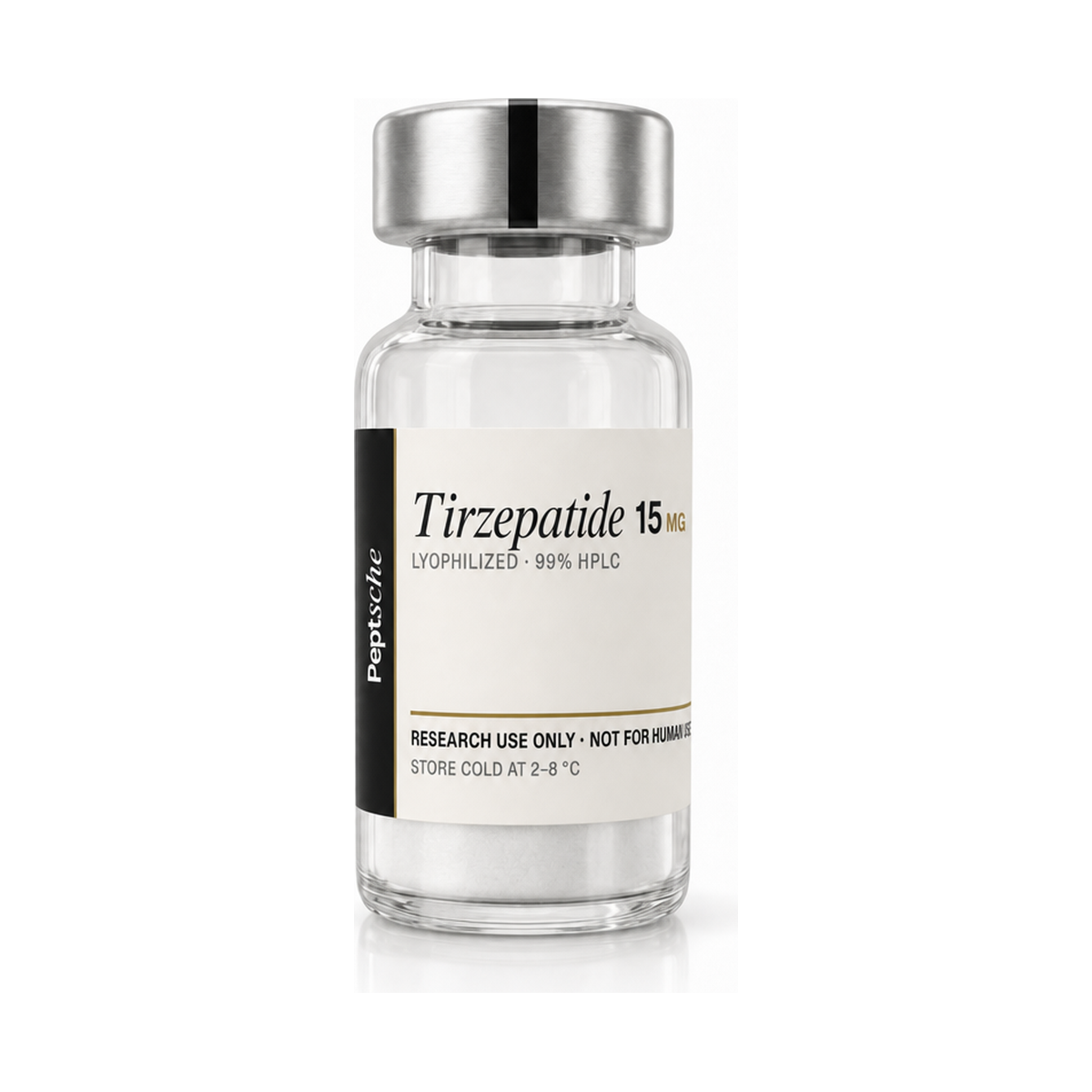
Tirzepatide is a synthetic 39 residue peptide engineered to engage two distinct incretin receptors, the glucose dependent insulinotropic polypeptide receptor and the glucagon like peptide 1 receptor, within a single scaffold. Its sequence incorporates two alpha aminoisobutyric acid residues that stabilise the backbone against enzymatic breakdown, together with a twenty carbon fatty diacid chain attached to a lysine side chain through a glutamate and ethylene glycol linker. Peptsche supplies it as a lyophilized powder sealed in a single use glass vial, a format that keeps the peptide stable through transport and cold storage. Peptsche supplies Tirzepatide strictly as a research material for controlled laboratory investigation.
Available Sizes
This listing covers one vial configuration. Every lot is assayed before release, so the stated purity applies to the batch shipped.
- 15mg vial of lyophilized Tirzepatide, 99% or greater purity by HPLC
Product Specifications
| Product | Tirzepatide (LY3298176) |
| Application | Research use only. Laboratory and in vitro investigation. |
| Appearance | White to off white lyophilized powder |
| Chemical Formula | C225H348N48O68 |
| Molecular Weight | 4813.5 g/mol |
| CAS Number | 2023788-19-2 |
| PubChem CID | 166567236 |
| Sequence | A 39 residue dual receptor agonist peptide, one letter YXEGTFTSDYSIXLDKIAQKAFVQWLIAGGPSSGAPPPS with a C terminal amide, where X at positions 2 and 13 is alpha aminoisobutyric acid and the lysine at position 20 carries a C20 diacid chain via a glutamate and ethylene glycol linker |
| Synonyms | LY3298176 |
| Purity | 99% or greater by HPLC, verified per batch |
| Storage | Store sealed at 2 to 8 °C, protected from heat, light and moisture |
| Regulatory Status | The tirzepatide molecule is the active ingredient in approved prescription medicines marketed as Mounjaro and Zepbound by Eli Lilly and Company, approved by the United States Food and Drug Administration in 2022. The material supplied by Peptsche is a research grade compound. It is not those approved medicines, is not manufactured to pharmaceutical standards, and is not approved for human or veterinary use. |
What is Tirzepatide?
Chemically the compound belongs to the class of long acting acylated peptide agonists, built on an incretin hormone architecture. Alpha aminoisobutyric acid was substituted at two positions where proteolytic cleavage would otherwise occur rapidly, constraining backbone geometry against the peptidases that clear native incretin sequences.
The second defining feature is acylation. A twenty carbon diacid is joined to the lysine at position 20 through a glutamate and ethylene glycol spacer. This lipid chain associates reversibly with serum albumin, the property separating the molecule from unmodified incretin peptides. The peptide carries a C terminal amide.
The published record comes from receptor pharmacology, cell culture, animal models and clinical programmes run by Eli Lilly and Company, the originator. Those clinical findings describe the pharmaceutical grade molecule as studied by its developer and do not characterise the research grade material offered here. Peptsche makes no claim that this compound produces any outcome in a human or animal subject.
Tirzepatide Mechanism of Action (Research Only)
Mechanistic accounts centre on simultaneous engagement of two receptors historically studied in isolation. The summaries below describe reported receptor level observations, not effects in humans.
Dual Incretin Receptor Agonism
A single molecule activates both incretin receptors. Both are class B G protein coupled receptors signalling through stimulatory G protein to adenylate cyclase, so the usual readout in cell based assays is cyclic adenosine monophosphate accumulation. Coskun and colleagues reported affinity at the glucose dependent insulinotropic polypeptide receptor comparable to native hormone, with weaker relative affinity at the glucagon like peptide 1 receptor.
Fatty Diacid Modification and Albumin Binding
The acyl chain has direct consequences for laboratory behaviour. In binding experiments the diacid associates non covalently with serum albumin, which investigators use to explain the extended circulating presence measured in animal work. The feature also matters in vitro, since albumin in culture medium competes for the compound and can shift apparent potency between assay formats.
Receptor Signalling Bias as a Research Question
At the glucagon like peptide 1 receptor the compound has been reported to favour cyclic adenosine monophosphate generation over beta arrestin recruitment relative to native ligand, with reduced receptor internalisation in the systems examined. Whether that biased profile explains differences from single receptor agonists remains an open question.
Integrated Mechanistic Profile
The preclinical literature describes Tirzepatide through three connected themes.
- Dual receptor engagement. Agonism at both incretin receptors from one molecular entity.
- Structural stabilisation. Alpha aminoisobutyric acid substitution and a C20 diacid chain that binds albumin reversibly.
- Biased signalling. Reported preference for cyclic nucleotide signalling over arrestin recruitment at one of the two receptors.
Note: Tirzepatide is supplied strictly for research use only. It is intended as an experimental compound for qualified laboratory personnel and is not a drug, food or cosmetic.
Tirzepatide is supplied exclusively for laboratory research use and is not intended for human or veterinary application.
Research Applications (Observations from Studies)
The areas below describe reported research uses.
Receptor Binding and Cell Based Signalling Assays
The most common use is as a reference agonist in transfected cell lines expressing one or both incretin receptors. Reported endpoints include competition binding constants, cyclic adenosine monophosphate concentration response curves, beta arrestin recruitment and receptor internalisation.
Islet and Adipocyte Culture Systems
Isolated pancreatic islets and cultured adipocytes appear frequently in the literature for this receptor pair. Reported observations concern signalling intermediates and transcriptional readouts in those preparations and reflect the conditions of each paper.
Analytical Reference and Clinical Literature Context
Laboratories developing chromatographic or mass spectrometric methods for acylated peptides use well characterised material to establish retention and fragmentation behaviour. The clinical reports listed below were conducted by Eli Lilly and Company using pharmaceutical grade material and say nothing about the research grade compound supplied here.
Tirzepatide is supplied exclusively for laboratory research use and is not intended for human or veterinary application.
Tirzepatide Compared With Related Research Compounds
The table below places Tirzepatide alongside two related compounds in the Peptsche range. It is offered to clarify differences in classification, molecular target and research context. It should not be read as a comparison of clinical performance, safety, or suitability for any application.
| Characteristic | Tirzepatide | Retatrutide | AOD-9604 |
| Research Classification | Synthetic 39 residue peptide acting as a dual GIP and GLP-1 receptor agonist | Synthetic 39 residue peptide acting as a triple glucagon, GIP and GLP-1 receptor agonist | Synthetic sixteen residue cyclic analogue of a carboxy terminal region of human growth hormone, not an incretin receptor ligand |
| Primary Molecular Target | Glucose dependent insulinotropic polypeptide receptor and glucagon like peptide 1 receptor | Glucagon receptor, glucose dependent insulinotropic polypeptide receptor and glucagon like peptide 1 receptor | No defined receptor target. Examined through the lipolytic domain hypothesis in adipose tissue preparations |
| Mechanistic Profile | Dual incretin receptor agonism from one molecular entity, with cyclic adenosine monophosphate accumulation as the usual assay readout | Simultaneous agonism at three related class B G protein coupled receptors, reported as an unbalanced rather than equal profile | Reproduces a discrete carboxy terminal domain of the parent hormone while omitting its growth promoting region, a route entirely separate from incretin receptor agonism |
| Primary Research Focus | Receptor binding and cell based signalling assays, islet and adipocyte culture systems, analytical reference work | Multiplexed receptor signalling assays, comparative polyagonist pharmacology, analytical method development | Adipose tissue and metabolic assays, animal joint tissue models, analytical detection and in vitro metabolism |
| Structural Design | 39 residues with two alpha aminoisobutyric acid substitutions and a C20 diacid chain on a lysine side chain, C terminal amide | 39 residues with alpha aminoisobutyric acid substitutions and a C20 diacid modified lysine, C terminal amide | Sixteen residues closed by a disulfide bridge between cysteines at positions 7 and 14, with a synthetic amino terminal tyrosine |
| Regulatory Status | The molecule is the active ingredient in approved medicines marketed as Mounjaro and Zepbound by Eli Lilly and Company. Material supplied is research grade, is not those medicines, and is not approved for human or veterinary use | Investigational compound in Phase 3 clinical development by Eli Lilly and Company. Not approved as a medicine in any jurisdiction and not approved for human or veterinary use | Research use compound, not approved for human or veterinary use in any jurisdiction, and appearing among the bulk drug substances withdrawn from consideration for compounding by the United States Food and Drug Administration |
Tirzepatide is supplied exclusively for laboratory research use and is not intended for human or veterinary application.
Laboratory Handling and Storage Considerations
Lyophilized Tirzepatide should be stored sealed at 2 to 8 °C, protected from heat, light and moisture. The powder is hygroscopic, so vials should reach ambient temperature before opening to prevent condensation onto the cake. Acylated peptides of this class are surface active and can adsorb to plastic, so low binding labware is commonly selected. Prepared solutions should be aliquoted rather than cycled through freezing and thawing, and every container should carry identity, lot number and preparation date.
Laboratory Safety Considerations
The practices below apply to routine handling in a research setting.
- Personal protective equipment: Wear nitrile gloves, a laboratory coat and safety glasses whenever a vial is open.
- Engineering controls: Weigh and prepare solutions in a certified fume hood to limit powder dispersal.
- Exposure prevention: Avoid skin, eye and mucous membrane contact and wash hands afterwards.
- Storage: Keep sealed vials at 2 to 8 °C in a dedicated research chemical location.
- Spill response: Collect spilled powder without raising dust and treat residue as chemical waste.
- Disposal: Discard unused material and contaminated consumables through the institutional chemical waste stream.
- Documentation: Record lot number, receipt date and each preparation so results stay traceable to a batch.
Certificate of Analysis and Quality Assurance
Every production lot of Tirzepatide supplied by Peptsche undergoes analytical evaluation, and a batch specific Certificate of Analysis accompanies each order to support research documentation, quality control and experimental consistency.
Each Certificate of Analysis typically includes:
- Identity verification using analytical techniques such as mass spectrometry to confirm the molecular characteristics of the material supplied.
- Purity analysis performed by high performance liquid chromatography to quantify purity and identify potential impurities.
- Batch documentation recording lot number, testing date, analytical methods applied and quality assessment results.
- Traceability information to support laboratory recordkeeping and reproducibility across research workflows.
Peptsche works with Janoshik Analytical, an independent testing laboratory, for third party verification of research material quality. Independent testing provides transparency and confidence in product identity, consistency and sourcing, and batch specific documentation can be retained as part of laboratory records and internal quality procedures.
Tirzepatide is supplied exclusively for laboratory research use and is not intended for human or veterinary application.
Frequently Asked Questions
What is Tirzepatide?
Tirzepatide is a synthetic 39 residue peptide engineered to engage two distinct incretin receptors within a single scaffold. The tirzepatide molecule is the active ingredient in approved prescription medicines marketed as Mounjaro and Zepbound by Eli Lilly and Company; the material supplied by Peptsche is a research grade compound, is not those approved medicines, is not manufactured to pharmaceutical standards and is not approved for human or veterinary use. Peptsche supplies it as a lyophilized powder sealed in a single use glass vial for controlled laboratory investigation.
What is Tirzepatide studied for in research?
Published laboratory work covers receptor binding and cell based signalling assays in transfected lines expressing one or both incretin receptors, islet and adipocyte culture systems, and analytical reference use for acylated peptides. The clinical reports listed in the references were conducted by Eli Lilly and Company using pharmaceutical grade material and say nothing about the research grade compound supplied here. These describe areas of laboratory study rather than established outcomes outside those experimental systems.
How does Tirzepatide work in laboratory research?
In the systems described in the literature the peptide activates two class B G protein coupled receptors, both signalling through stimulatory G protein to adenylate cyclase, so cyclic adenosine monophosphate accumulation is the usual readout in cell based assays. Two alpha aminoisobutyric acid substitutions constrain the backbone against peptidase cleavage, and a twenty carbon diacid chain associates reversibly with serum albumin. At one of the two receptors the compound has been reported to favour cyclic nucleotide signalling over beta arrestin recruitment relative to native ligand.
How is the quality of Peptsche Tirzepatide verified?
Every production lot of Peptsche Tirzepatide is evaluated analytically, with identity confirmed using techniques such as mass spectrometry and purity quantified by high performance liquid chromatography against the stated specification of 99% or greater. Peptsche works with Janoshik Analytical, an independent testing laboratory, for third party verification, and a batch specific Certificate of Analysis accompanies each order.
How should unopened Tirzepatide be stored?
Unopened vials should be stored sealed at 2 to 8 °C, protected from heat, light and moisture. Vials should reach ambient temperature before opening so condensation does not form on the cold powder. Lot number, receipt date and storage conditions should be recorded in laboratory documentation so results stay traceable to a batch.
Is Tirzepatide intended for human use?
No. Tirzepatide is supplied strictly for laboratory research use only. It is not approved for human consumption, veterinary use, diagnosis, treatment or any medical application.
Why do researchers choose Peptsche for Tirzepatide?
Peptsche supplies Tirzepatide at 99% or greater purity by HPLC, verified per batch, as a lyophilized powder sealed in a single use glass vial that stays stable through transport and cold storage. Every lot is released against batch specific analytical documentation, and independent third party confirmatory analysis supports traceability and reproducibility across research workflows.
Scientific References
- Coskun T, Sloop KW, Loghin C, Alsina-Fernandez J, Urva S, Bokvist KB, Cui X, Briere DA, et al. LY3298176, a novel dual GIP and GLP-1 receptor agonist for the treatment of type 2 diabetes mellitus: From discovery to clinical proof of concept. Molecular Metabolism. 2018;18:3 to 14. https://pubmed.ncbi.nlm.nih.gov/30473097/
- Frías JP, Davies MJ, Rosenstock J, Pérez Manghi FC, Fernández Landó L, Bergman BK, Liu B, Cui X, Brown K. Tirzepatide versus Semaglutide Once Weekly in Patients with Type 2 Diabetes. New England Journal of Medicine. 2021;385(6):503 to 515. https://pubmed.ncbi.nlm.nih.gov/34170647/
- Jastreboff AM, Aronne LJ, Ahmad NN, Wharton S, Connery L, Alves B, Kiyosue A, Zhang S, Liu B, Bunck MC, Stefanski A. Tirzepatide Once Weekly for the Treatment of Obesity. New England Journal of Medicine. 2022;387(3):205 to 216. https://pubmed.ncbi.nlm.nih.gov/35658024/
RESEARCH USE ONLY
These compounds are NOT intended for human consumption, clinical use, or veterinary applications. We are not affiliated with any pharmaceutical companies or their commercial medications. By placing an order, you certify these materials will be used exclusively for in vitro testing and laboratory experimentation only. Bodily introduction of any kind into humans or animals is strictly forbidden by law. This product should only be handled by licensed, qualified professionals. This product is not a drug, food, or cosmetic and may not be misbranded, misused or mislabeled as a drug, food or cosmetic.