

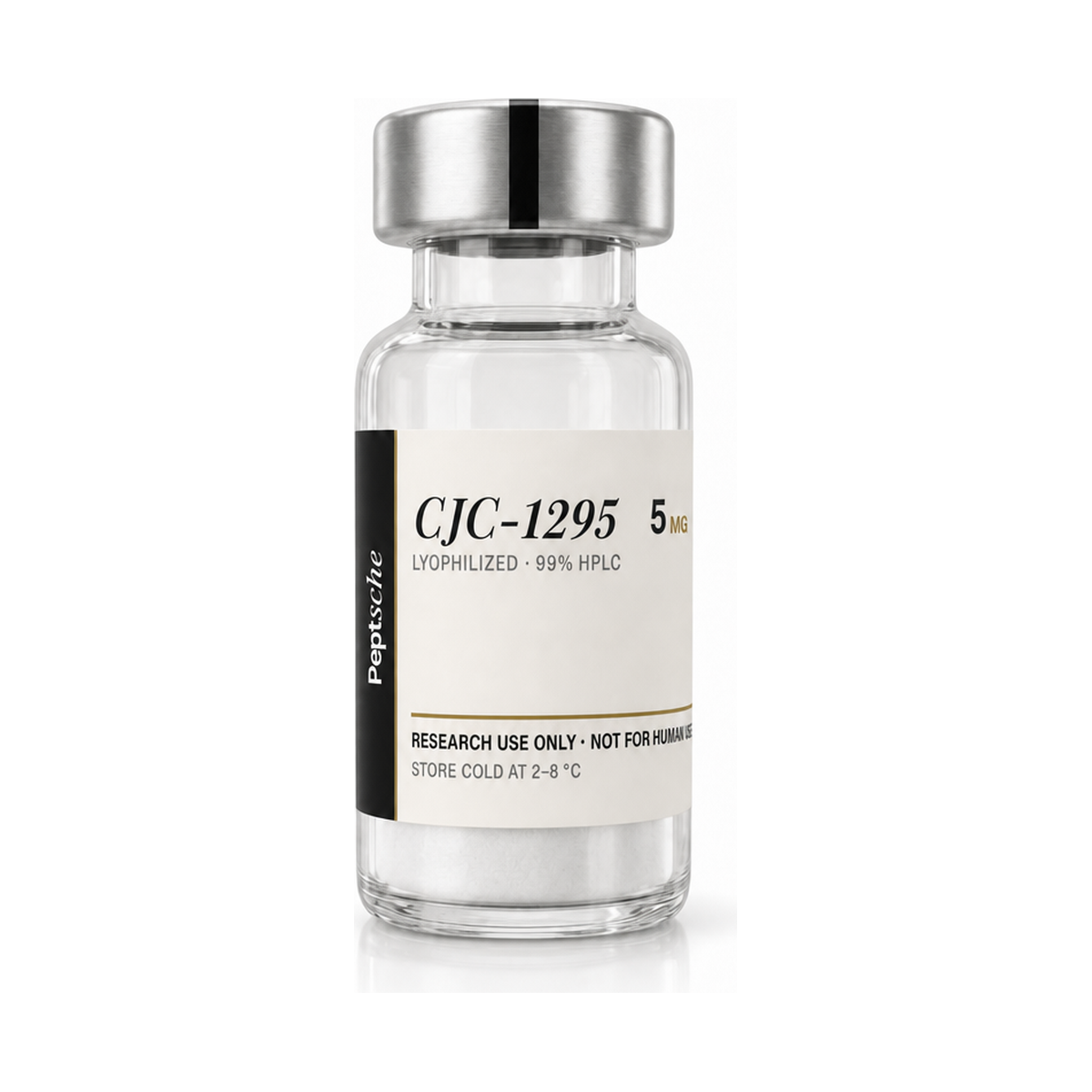
About CJC-1295
CJC-1295 without DAC, also catalogued as Modified GRF 1-29, is a synthetic 29 residue analogue of the growth hormone releasing factor produced by the hypothalamus. It reproduces the active amino terminal fragment of that peptide while carrying four amino acid substitutions that resist enzymatic breakdown. Peptsche offers it as a lyophilized powder in a sealed vial, made by solid phase synthesis and characterised by chromatography and mass spectrometry. Peptsche supplies CJC-1295 strictly as a research material for controlled laboratory investigation.
Available Sizes
Offered in a single vial configuration, sealed with a butyl closure and crimp.
- 5 mg lyophilized CJC-1295 without DAC per vial
Product Specifications
| Product | CJC-1295 without DAC, research grade lyophilized powder |
| Application | In vitro and laboratory research use only. Not for human or veterinary use. |
| Appearance | White to off white powder |
| Chemical Formula | C152H252N44O42 |
| Molecular Weight | 3367.9 g/mol |
| CAS Number | Pending verification. Public chemical registries currently disagree on the assignment for the form without DAC, so Peptsche does not publish a CAS number for this product. |
| PubChem CID | 56841945 |
| Sequence | Tyr D-Ala Asp Ala Ile Phe Thr Gln Ser Tyr Arg Lys Val Leu Ala Gln Leu Ser Ala Arg Lys Leu Leu Gln Asp Ile Leu Ser Arg NH2 (a 29 residue analogue of growth hormone releasing factor) |
| Synonyms | Mod GRF 1-29, Modified GRF (1-29), CJC-1295 no DAC |
| Purity | 99% or greater by HPLC, verified per batch |
| Storage | Store sealed at 2 to 8 °C, protected from heat, light and moisture |
| Regulatory Status | Research use compound. Not approved for human or veterinary use in any jurisdiction. CJC-1295 was withdrawn from consideration on the United States Food and Drug Administration bulk drug substances list. |
What is CJC-1295?
Growth hormone releasing factor is a hypothalamic peptide acting on the anterior pituitary through a class B G protein coupled receptor. The endogenous molecule spans 44 amino acids, but the first 29 carry essentially all of its receptor binding and activating capacity, and that fragment became the scaffold for a family of synthetic analogues.
Its chemical distinction lies in four substitutions at sites recognised by proteases. D-alanine at the second residue removes the principal cleavage point, and the remaining changes limit oxidation and deamidation. The molecule has a free amino terminus and no albumin binding moiety, making it the unconjugated tetrasubstituted analogue, not the drug affinity complex derivative.
The literature deserves plain statement. No peer reviewed literature studies the form without DAC under that name. The Jetté 2005 paper characterises the unconjugated tetrasubstituted analogue, the parent peptide of the material offered here, while the other cited work used the DAC conjugated form, in which a linker couples the peptide to albumin and gives a very different plasma profile. Researchers should account for this when reading the literature.
CJC-1295 Mechanism of Action (Research Only)
Mechanistic interest here is confined to one receptor system and the modifications altering ligand persistence.
Growth Hormone Releasing Factor Receptor Agonism
The peptide binds the growth hormone releasing factor receptor on somatotroph cells of the anterior pituitary. That receptor belongs to the secretin family and signals through the stimulatory G protein, raising cyclic adenosine monophosphate and activating protein kinase A. Cell based readouts include cyclic nucleotide accumulation and secretory output from pituitary cultures. The amino terminal region activates and the carboxyl terminal helix binds.
Four Amino Acid Substitutions and Enzymatic Resistance
Dipeptidyl peptidase cleaves the first two residues from the native fragment within minutes in serum, giving an inactive product. D-alanine at the second position blocks that reaction because the enzyme active site cannot accommodate the inverted stereocentre. Further substitutions address deamidation and oxidation, so measured concentration tracks nominal concentration closely in stability assays.
Absence of the Drug Affinity Complex
The conjugated derivative carries a maleimidopropionic acid group that reacts with a free cysteine on serum albumin, tethering the peptide to a long lived carrier and extending its plasma residence. The material here lacks that group, so its plasma profile is shorter and receptor exposure is a brief pulse rather than a sustained plateau. This is the key variable when comparing the two forms.
Integrated Mechanistic Profile
- Receptor engagement: selective agonism at the growth hormone releasing factor receptor of the pituitary.
- Chemical stabilisation: four substitutions confer resistance to enzymatic degradation.
- Shorter plasma profile: absence of the drug affinity complex gives transient rather than sustained exposure.
Note: CJC-1295 is supplied strictly for research use only. It is intended as an experimental compound for qualified laboratory personnel and is not a drug, food or cosmetic.
CJC-1295 is supplied exclusively for laboratory research use and is not intended for human or veterinary application.
Research Applications (Observations from Studies)
The summaries below describe published research on this class of analogue. They are not statements about the product offered for sale.
Receptor Pharmacology and Binding Studies
Analogues of the 29 residue fragment have been used in systems expressing the recombinant receptor to map binding affinity and agonist efficacy, by competition binding and cyclic nucleotide accumulation.
Comparative Stability Investigations
Investigators incubate the substituted analogue alongside the unmodified fragment in serum or in buffers containing purified peptidases, following loss of parent species by mass spectrometry.
Analytical Method Development
Because the molecule is well defined and highly pure, it serves as a reference standard for laboratories developing quantitative assays for peptides of similar size and for calibrating chromatography methods.
CJC-1295 is supplied exclusively for laboratory research use and is not intended for human or veterinary application.
CJC-1295 Compared With Related Research Compounds
The table below places CJC-1295 alongside two related compounds in the Peptsche range. It is offered to clarify differences in classification, molecular target and research context. It should not be read as a comparison of clinical performance, safety, or suitability for any application.
| Characteristic | CJC-1295 | Ipamorelin | Sermorelin |
| Research Classification | Synthetic 29 residue analogue of growth hormone releasing factor | Synthetic pentapeptide growth hormone secretagogue | Synthetic 29 residue fragment of human growth hormone releasing hormone |
| Primary Molecular Target | Growth hormone releasing factor receptor on pituitary somatotrophs | Ghrelin receptor GHS-R1a on pituitary somatotrophs | Growth hormone releasing hormone receptor on pituitary somatotrophs |
| Mechanistic Profile | Agonism at the growth hormone releasing hormone receptor, with a brief plasma profile | Agonism at the ghrelin receptor GHS-R1a, a receptor system separate from the growth hormone releasing hormone receptor | Agonism at the growth hormone releasing hormone receptor, unmodified parent scaffold |
| Primary Research Focus | Receptor pharmacology, comparative stability and analytical method development | Pituitary cell and receptor assays, rodent skeletal endpoints, comparative secretagogue pharmacology | Reference comparator in analogue design, peptide modification chemistry, endocrine signalling models |
| Structural Design | 29 residues with four substitutions, no albumin binding moiety | Five residues including non standard Aib and D configured aromatic residues, amidated terminus | Residues 1 to 29 with a terminal amide, one methionine, no unnatural residues |
| Regulatory Status | Research use compound, not approved for human or veterinary use in any jurisdiction, and withdrawn from consideration on the United States Food and Drug Administration bulk drug substances list | Research use compound, not approved for human or veterinary use in any jurisdiction, and placed in Category 2 of the United States Food and Drug Administration list of bulk drug substances | Formerly the active ingredient in an approved medicine marketed as Geref by EMD Serono, with all products under those applications now discontinued. Material supplied is research grade, is not that former medicine, and is not approved for human or veterinary use |
CJC-1295 is supplied exclusively for laboratory research use and is not intended for human or veterinary application.
Laboratory Handling and Storage Considerations
Lyophilized peptide of this length is hygroscopic and takes up moisture once the seal is broken. Vials should reach ambient temperature before opening so condensation does not form on the cold powder. Sealed vials are stable at 2 to 8 °C when kept dry and dark.
In solution the material is far less stable. Solutions should be sterile filtered, buffered, refrigerated, protected from light and used within a window set by the laboratory's own stability testing. Repeated freezing and thawing causes aggregation, so aliquoting into single use portions is standard. Glass or low binding polypropylene labware is preferred because these peptides adsorb to untreated plastic.
Laboratory Safety Considerations
- Personal protective equipment: laboratory coat, nitrile gloves and eye protection whenever the vial is open.
- Engineering controls: handle open vials inside a certified fume hood or containment enclosure.
- Exposure prevention: avoid contact with skin and eyes, do not inhale the powder, never pipette by mouth.
- Storage: keep sealed at 2 to 8 °C, protected from heat, light and moisture, in a restricted area.
- Spill response: restrict access, avoid raising dust, collect with a damp wipe, then decontaminate and seal the waste.
- Disposal: treat unused material and contaminated consumables as chemical laboratory waste under institutional rules.
- Documentation: record lot number, receipt date, storage conditions and quantities used for traceability.
Certificate of Analysis and Quality Assurance
Every production lot of CJC-1295 supplied by Peptsche undergoes analytical evaluation, and a batch specific Certificate of Analysis accompanies each order to support research documentation, quality control and experimental consistency.
Each Certificate of Analysis typically includes:
- Identity verification using analytical techniques such as mass spectrometry to confirm the molecular characteristics of the material supplied.
- Purity analysis performed by high performance liquid chromatography to quantify purity and identify potential impurities.
- Batch documentation recording lot number, testing date, analytical methods applied and quality assessment results.
- Traceability information to support laboratory recordkeeping and reproducibility across research workflows.
Peptsche works with Janoshik Analytical, an independent testing laboratory, for third party verification of research material quality. Independent testing provides transparency and confidence in product identity, consistency and sourcing, and batch specific documentation can be retained as part of laboratory records and internal quality procedures.
CJC-1295 is supplied exclusively for laboratory research use and is not intended for human or veterinary application.
Frequently Asked Questions
What is CJC-1295?
CJC-1295 without DAC, also catalogued as Modified GRF 1-29, is a synthetic 29 residue analogue of the growth hormone releasing factor produced by the hypothalamus. It reproduces the active amino terminal fragment of that peptide while carrying four amino acid substitutions that resist enzymatic breakdown. Peptsche supplies it as a lyophilized powder in a sealed vial for controlled laboratory investigation.
What is CJC-1295 studied for in research?
Published work on this class of analogue covers receptor pharmacology and binding studies, comparative stability investigations and analytical method development. Because the molecule is well defined and highly pure, it also serves as a reference standard for laboratories developing quantitative peptide assays. These describe areas of laboratory study rather than established outcomes outside those experimental systems.
How does CJC-1295 work in laboratory research?
In the systems described in the literature the peptide binds the growth hormone releasing factor receptor on somatotroph cells of the anterior pituitary, a secretin family receptor signalling through the stimulatory G protein. Four amino acid substitutions confer resistance to enzymatic degradation. Because the material carries no albumin binding moiety, receptor exposure is a brief pulse rather than a sustained plateau.
How is the quality of Peptsche CJC-1295 verified?
Every production lot of Peptsche CJC-1295 is evaluated analytically, with identity confirmed using techniques such as mass spectrometry and purity quantified by high performance liquid chromatography. Peptsche works with Janoshik Analytical, an independent testing laboratory, for third party verification, and a batch specific Certificate of Analysis accompanies each order.
How should unopened CJC-1295 be stored?
Unopened vials should be stored sealed at 2 to 8 °C, protected from heat, light and moisture. Vials should reach ambient temperature before opening so condensation does not form on the cold powder. Lot number, receipt date and storage conditions should be recorded in laboratory documentation so results stay traceable to a batch.
Is CJC-1295 intended for human use?
No. CJC-1295 is supplied strictly for laboratory research use only. It is not approved for human consumption, veterinary use, diagnosis, treatment or any medical application.
Why do researchers choose Peptsche for CJC-1295?
Peptsche supplies CJC-1295 at 99% or greater purity by HPLC, verified per batch, as a lyophilized powder in a vial sealed with a butyl closure and crimp. Each lot is released against batch specific analytical documentation, and independent third party confirmatory analysis supports reproducibility across research workflows.
Scientific References
- Jetté L, Léger R, Thibaudeau K, Benquet C, Robitaille M, Pellerin I, Paradis V, van Wyk P, et al. Human growth hormone-releasing factor (hGRF)1-29-albumin bioconjugates activate the GRF receptor on the anterior pituitary in rats: identification of CJC-1295 as a long-lasting GRF analog. Endocrinology. 2005;146(7):3052 to 3058. https://pubmed.ncbi.nlm.nih.gov/15817669/
- Teichman SL, Neale A, Lawrence B, Gagnon C, Castaigne JP, Frohman LA. Prolonged stimulation of growth hormone (GH) and insulin-like growth factor I secretion by CJC-1295, a long-acting analog of GH-releasing hormone, in healthy adults. Journal of Clinical Endocrinology and Metabolism. 2006;91(3):799 to 805. https://pubmed.ncbi.nlm.nih.gov/16352683/ (this study examined the DAC conjugated form)
- Ionescu M, Frohman LA. Pulsatile secretion of growth hormone (GH) persists during continuous stimulation by CJC-1295, a long-acting GH-releasing hormone analog. Journal of Clinical Endocrinology and Metabolism. 2006;91(12):4792 to 4797. https://pubmed.ncbi.nlm.nih.gov/17018654/ (this study examined the DAC conjugated form)
RESEARCH USE ONLY
These compounds are NOT intended for human consumption, clinical use, or veterinary applications. We are not affiliated with any pharmaceutical companies or their commercial medications. By placing an order, you certify these materials will be used exclusively for in vitro testing and laboratory experimentation only. Bodily introduction of any kind into humans or animals is strictly forbidden by law. This product should only be handled by licensed, qualified professionals. This product is not a drug, food, or cosmetic and may not be misbranded, misused or mislabeled as a drug, food or cosmetic.