

About Ipamorelin
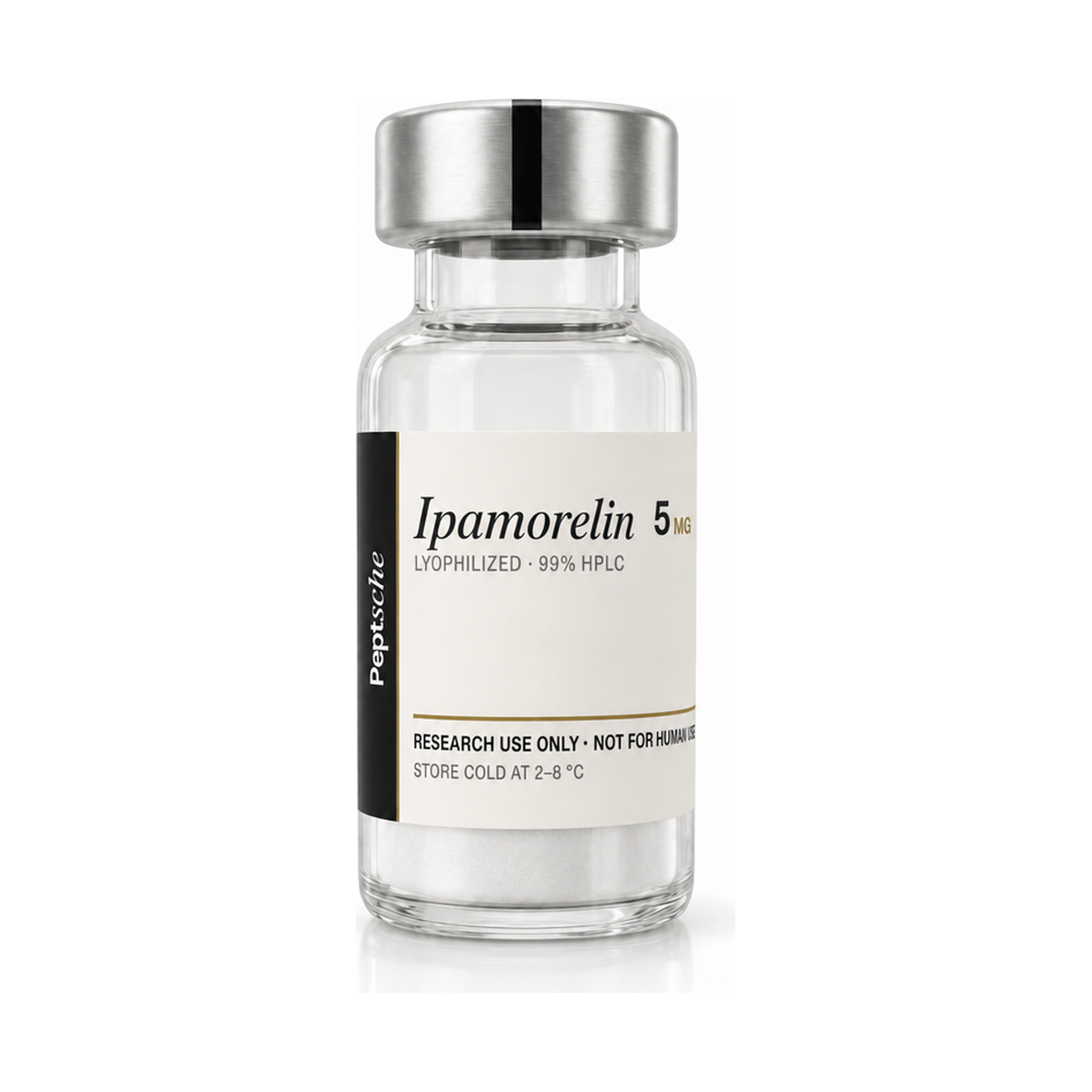
Ipamorelin is a synthetic pentapeptide with the molecular formula C38H49N9O5 and a molecular weight of 711.9 g/mol, assembled from the residue sequence Aib His D-2-Nal D-Phe Lys NH2. Peptsche supplies it as a lyophilized powder sealed in a single use glass vial, a form that keeps the peptide stable through transport and cold storage. In the published literature ipamorelin has been studied in connection with ghrelin receptor pharmacology, growth hormone secretagogue selectivity, pituitary cell signalling and skeletal endpoints in rodent models. Peptsche supplies Ipamorelin strictly as a research material for controlled laboratory investigation.
Available Sizes
This listing covers one vial configuration. Every lot is assayed before release, so the stated purity applies to the batch shipped.
- 5mg vial of lyophilized Ipamorelin, 99% or greater purity by HPLC
Product Specifications
| Product | Ipamorelin |
| Application | Research use only. Laboratory and in vitro investigation. |
| Appearance | White to off white lyophilized powder |
| Chemical Formula | C38H49N9O5 |
| Molecular Weight | 711.9 g/mol |
| CAS Number | 170851-70-4 |
| PubChem CID | 9831659 |
| Sequence | Aib His D-2-Nal D-Phe Lys NH2 |
| Synonyms | NNC 26-0161, ipamorelin acetate |
| Purity | 99% or greater by HPLC, verified per batch |
| Storage | Store sealed at 2 to 8 °C, protected from heat, light and moisture |
| Regulatory Status | Research use compound. Not approved for human or veterinary use in any jurisdiction. Placed in Category 2 of the United States Food and Drug Administration list of bulk drug substances that may present significant safety risks. |
What is Ipamorelin?
Chemically, ipamorelin is a short synthetic peptide of five residues carrying an amidated carboxy terminus. Two of its building blocks are not standard proteinogenic amino acids: alpha aminoisobutyric acid, abbreviated Aib, and the D configured naphthylalanine residue D-2-Nal. With the D configured phenylalanine, these substitutions give the molecule a constrained conformation and greater resistance to enzymatic breakdown in the assay conditions used.
The compound was developed in the 1990s and carries the laboratory code NNC 26-0161. Raun and colleagues described it in 1998 as the first selective growth hormone secretagogue, a characterisation based on comparisons with earlier peptides in the same class. Follow up rodent work by Johansen and by Svensson examined skeletal endpoints, and those three papers form the core of the primary literature.
The evidence base for ipamorelin is preclinical. Published findings come from receptor assays, isolated pituitary cell preparations and rodent studies, and they describe what was observed in those defined systems. Ipamorelin is not approved for human or veterinary use in any jurisdiction and appears in Category 2 of the Food and Drug Administration list of bulk drug substances that may present significant safety risks.
Ipamorelin Mechanism of Action (Research Only)
Mechanistic accounts centre on interaction with a single receptor and on the selectivity that follows from the compact structure. The summaries below describe reported preclinical observations, not effects in humans.
Ghrelin Receptor GHS-R1a Agonism
Ipamorelin is characterised in the literature as an agonist at the growth hormone secretagogue receptor GHS-R1a, the same receptor engaged by the endogenous peptide ghrelin. In receptor assays and isolated pituitary preparations, investigators reported engagement and downstream signalling consistent with that classification, and antagonist studies were used to confirm that the responses depend on the receptor.
Secretagogue Selectivity Relative to Earlier Peptides
The point emphasised by Raun and colleagues is selectivity. In the comparisons reported in that work, ipamorelin produced growth hormone release in the models used without the parallel changes in other pituitary and adrenal hormones seen with earlier compounds in the class. Later work, including Svensson's comparison against GHRP-6, used the two peptides as contrasting probes of the same receptor system.
Pentapeptide Structure and Receptor Binding
Structure activity work relates the observed selectivity to the compact pentapeptide scaffold. The Aib residue restricts backbone flexibility, the D configured aromatic residues occupy a hydrophobic pocket described in binding models, and the amidated terminus removes a charged group. Together these features are described as producing a defined binding mode.
Integrated Mechanistic Profile
The preclinical literature describes ipamorelin through three connected themes.
- Single receptor engagement. Agonism at GHS-R1a reported in receptor assays and isolated pituitary preparations.
- Selectivity. Growth hormone release in the models used without the broader hormonal changes reported for earlier secretagogues.
- Structural constraint. Non standard residues that restrict conformation and define the binding mode in the systems tested.
Note: Ipamorelin is supplied strictly for research use only. It is intended as an experimental compound for qualified laboratory personnel and is not a drug, food or cosmetic.
Ipamorelin is supplied exclusively for laboratory research use and is not intended for human or veterinary application.
Research Applications (Observations from Studies)
The areas below describe how ipamorelin has been used as a research tool and what was reported.
Pituitary Cell and Receptor Assay Systems
Isolated pituitary cell preparations and cells expressing the cloned receptor are the standard systems for this compound. Reported endpoints include receptor binding measurements, second messenger readouts and hormone concentrations in culture medium. Because it is described as selective, it is often used to isolate one arm of a signalling system that other probes engage more broadly.
Skeletal Endpoints in Rodent Models
Johansen and colleagues examined longitudinal bone growth in rats, and Svensson and colleagues measured bone mineral content in adult female rats alongside GHRP-6. In the animal models used, investigators reported measurable differences in the skeletal parameters recorded. Those findings are specific to the species and conditions described in each paper.
Comparative Secretagogue Pharmacology
Ipamorelin appears frequently as a reference compound when newer molecules at the same receptor are characterised. In that role it provides a comparison point for binding affinity, selectivity profiling and assay validation.
Ipamorelin is supplied exclusively for laboratory research use and is not intended for human or veterinary application.
Ipamorelin Compared With Related Research Compounds
The table below places Ipamorelin alongside two related compounds in the Peptsche range. It is offered to clarify differences in classification, molecular target and research context. It should not be read as a comparison of clinical performance, safety, or suitability for any application.
| Characteristic | Ipamorelin | CJC-1295 | Sermorelin |
| Research Classification | Synthetic pentapeptide growth hormone secretagogue | Synthetic 29 residue analogue of growth hormone releasing factor | Synthetic 29 residue fragment of human growth hormone releasing hormone |
| Primary Molecular Target | Ghrelin receptor GHS-R1a on pituitary somatotrophs | Growth hormone releasing factor receptor on pituitary somatotrophs | Growth hormone releasing hormone receptor on pituitary somatotrophs |
| Mechanistic Profile | Agonism at the ghrelin receptor GHS-R1a, a receptor system separate from the growth hormone releasing hormone receptor | Agonism at the growth hormone releasing hormone receptor, with a brief plasma profile | Agonism at the growth hormone releasing hormone receptor, unmodified parent scaffold |
| Primary Research Focus | Pituitary cell and receptor assays, rodent skeletal endpoints, comparative secretagogue pharmacology | Receptor pharmacology, comparative stability and analytical method development | Reference comparator in analogue design, peptide modification chemistry, endocrine signalling models |
| Structural Design | Five residues including non standard Aib and D configured aromatic residues, amidated terminus | 29 residues with four substitutions, no albumin binding moiety | Residues 1 to 29 with a terminal amide, one methionine, no unnatural residues |
| Regulatory Status | Research use compound, not approved for human or veterinary use in any jurisdiction, and placed in Category 2 of the United States Food and Drug Administration list of bulk drug substances | Research use compound, not approved for human or veterinary use in any jurisdiction, and withdrawn from consideration on the United States Food and Drug Administration bulk drug substances list | Formerly the active ingredient in an approved medicine marketed as Geref by EMD Serono, with all products under those applications now discontinued. Material supplied is research grade, is not that former medicine, and is not approved for human or veterinary use |
Ipamorelin is supplied exclusively for laboratory research use and is not intended for human or veterinary application.
Laboratory Handling and Storage Considerations
Lyophilized ipamorelin should be stored sealed at 2 to 8 °C, protected from heat, light and moisture. The powder is hygroscopic, so vials should reach ambient temperature before opening. Peptides of this class are sensitive to extremes of pH and to prolonged storage in solution, so prepared solutions should be aliquoted rather than cycled repeatedly through freezing and thawing, and each container should carry compound identity, lot number and preparation date.
Laboratory Safety Considerations
The practices below apply to routine handling in a research setting.
- Personal protective equipment: Wear nitrile gloves, a laboratory coat and side shield safety glasses whenever a vial is open.
- Engineering controls: Weigh and prepare solutions in a certified fume hood to limit dispersal of the fine powder.
- Exposure prevention: Avoid skin, eye and mucous membrane contact, keep food out of the working area and wash hands afterwards.
- Storage: Keep sealed vials at 2 to 8 °C in a dedicated research chemical location, separated from consumer products.
- Spill response: Collect spilled powder without raising dust, decontaminate the surface and treat the residue as chemical waste.
- Disposal: Discard unused material, solutions and contaminated consumables through the institutional chemical waste stream.
- Documentation: Record lot number, receipt date, storage conditions and each preparation so that results stay traceable to a batch.
Certificate of Analysis and Quality Assurance
Every production lot of Ipamorelin supplied by Peptsche undergoes analytical evaluation, and a batch specific Certificate of Analysis accompanies each order to support research documentation, quality control and experimental consistency.
Each Certificate of Analysis typically includes:
- Identity verification using analytical techniques such as mass spectrometry to confirm the molecular characteristics of the material supplied.
- Purity analysis performed by high performance liquid chromatography to quantify purity and identify potential impurities.
- Batch documentation recording lot number, testing date, analytical methods applied and quality assessment results.
- Traceability information to support laboratory recordkeeping and reproducibility across research workflows.
Peptsche works with Janoshik Analytical, an independent testing laboratory, for third party verification of research material quality. Independent testing provides transparency and confidence in product identity, consistency and sourcing, and batch specific documentation can be retained as part of laboratory records and internal quality procedures.
Ipamorelin is supplied exclusively for laboratory research use and is not intended for human or veterinary application.
Frequently Asked Questions
What is Ipamorelin?
Ipamorelin is a synthetic pentapeptide assembled from the residue sequence Aib His D-2-Nal D-Phe Lys NH2, with a molecular weight of 711.9 g/mol. Two of its building blocks are not standard proteinogenic amino acids, which gives the molecule a constrained conformation and greater resistance to enzymatic breakdown. Peptsche supplies it as a lyophilized powder sealed in a single use glass vial.
What is Ipamorelin studied for in research?
Published investigation is preclinical and spans ghrelin receptor pharmacology, growth hormone secretagogue selectivity, pituitary cell signalling and skeletal endpoints in rodent models. Ipamorelin also appears frequently as a reference compound when newer molecules at the same receptor are characterised. Those findings are specific to the species and conditions described in each paper.
How does Ipamorelin work in laboratory research?
The literature characterises ipamorelin as an agonist at the growth hormone secretagogue receptor GHS-R1a, the same receptor engaged by the endogenous peptide ghrelin. Antagonist studies were used to confirm that the reported responses depend on that receptor. The compact pentapeptide scaffold and its non standard residues are described as producing a defined binding mode.
How is the quality of Peptsche Ipamorelin verified?
Every production lot of Peptsche Ipamorelin is evaluated analytically, with identity confirmed using techniques such as mass spectrometry and purity quantified by high performance liquid chromatography. Peptsche works with Janoshik Analytical, an independent testing laboratory, for third party verification, and a batch specific Certificate of Analysis accompanies each order.
How should unopened Ipamorelin be stored?
Unopened vials should be stored sealed at 2 to 8 °C, protected from heat, light and moisture. Vials should reach ambient temperature before opening so condensation does not form on the cold powder. Lot number, receipt date and storage conditions should be recorded in laboratory documentation so results stay traceable to a batch.
Is Ipamorelin intended for human use?
No. Ipamorelin is supplied strictly for laboratory research use only. It is not approved for human consumption, veterinary use, diagnosis, treatment or any medical application.
Why do researchers choose Peptsche for Ipamorelin?
Peptsche supplies Ipamorelin at 99% or greater purity by HPLC, verified per batch, sealed in a single use glass vial. Every lot is assayed before release, so the stated purity applies to the batch shipped, and independent third party verification with full lot traceability supports reproducibility across research workflows.
Scientific References
- Raun K, Hansen BS, Johansen NL, Thøgersen H, Madsen K, Ankersen M, Andersen PH. Ipamorelin, the first selective growth hormone secretagogue. European Journal of Endocrinology. 1998;139(5):552 to 561. https://pubmed.ncbi.nlm.nih.gov/9849822/
- Johansen PB, Nowak J, Skjaerbaek C, Flyvbjerg A, Andreassen TT, Wilken M, Orskov H. Ipamorelin, a new growth-hormone-releasing peptide, induces longitudinal bone growth in rats. Growth Hormone and IGF Research. 1999;9(2):106 to 113. https://pubmed.ncbi.nlm.nih.gov/10373343/
- Svensson J, Lall S, Dickson SL, Bengtsson BA, Rømer J, Ahnfelt-Rønne I, Ohlsson C, Jansson JO. The GH secretagogues ipamorelin and GH-releasing peptide-6 increase bone mineral content in adult female rats. Journal of Endocrinology. 2000;165(3):569 to 577. https://pubmed.ncbi.nlm.nih.gov/10828840/
RESEARCH USE ONLY
These compounds are NOT intended for human consumption, clinical use, or veterinary applications. We are not affiliated with any pharmaceutical companies or their commercial medications. By placing an order, you certify these materials will be used exclusively for in vitro testing and laboratory experimentation only. Bodily introduction of any kind into humans or animals is strictly forbidden by law. This product should only be handled by licensed, qualified professionals. This product is not a drug, food, or cosmetic and may not be misbranded, misused or mislabeled as a drug, food or cosmetic.