

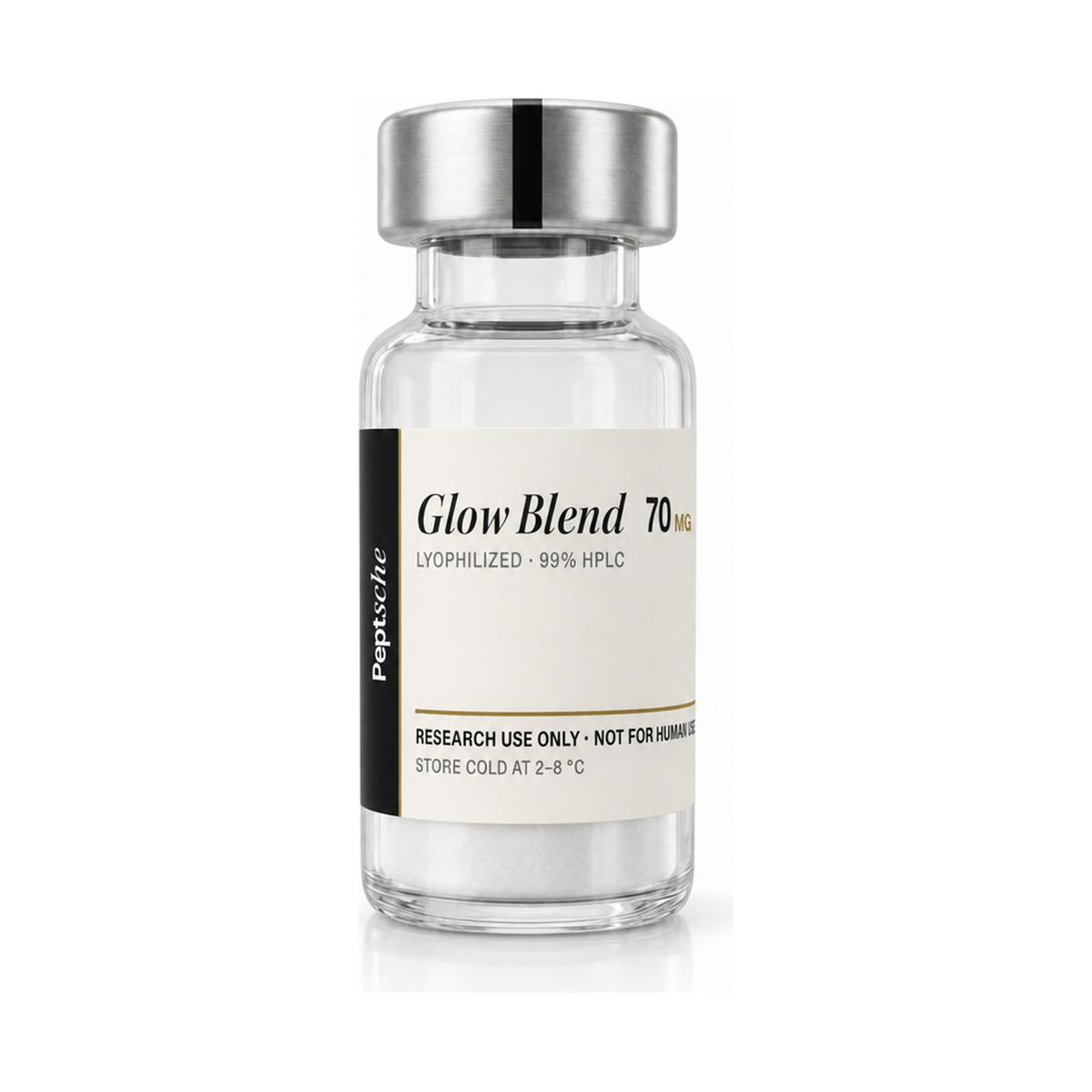
About Glow Blend
Glow Blend is a three component research preparation in which BPC-157, TB-500 and GHK-Cu are co lyophilized in a single sealed vial, giving 70 mg of total peptide content. The three materials are chemically unrelated and act through different reported mechanisms, so the preparation is best understood as three distinct research materials in one container rather than a single chemical entity. As a mixture it has no single formula, molecular weight or CAS number; components are specified separately below. Peptsche supplies Glow Blend strictly as a research material for controlled laboratory investigation.
Available Sizes
This listing covers one vial configuration. Each component is assayed before blending, so the stated purity applies to the batch shipped.
- 70mg vial of co lyophilized Glow Blend, comprising BPC-157 10 mg, TB-500 10 mg and GHK-Cu 50 mg, each 99% or greater purity by HPLC
Product Specifications
| Product | Glow Blend (BPC-157, TB-500 and GHK-Cu) |
| Application | Research use only. Laboratory and in vitro investigation. |
| Appearance | Lyophilized powder with a blue tint imparted by the copper complex of the GHK-Cu component |
| Composition | BPC-157 10 mg, TB-500 10 mg and GHK-Cu 50 mg, co lyophilized in a single vial |
| BPC-157 Component | Chemical formula C62H98N16O22, molecular weight 1419.5 g/mol, CAS 137525-51-0, PubChem CID 9941957, sequence Gly Glu Pro Pro Pro Gly Lys Pro Ala Asp Asp Ala Gly Leu Val |
| TB-500 Component | Chemical formula C38H68N10O14, molecular weight 889.0 g/mol, CAS 885340-08-9, PubChem CID 62707662, sequence Ac Leu Lys Lys Thr Glu Thr Gln OH |
| GHK-Cu Component | Chemical formula C14H22N6O4·Cu, molecular weight 401.91 g/mol, CAS 89030-95-5, PubChem CID 71587328, peptide component Gly-His-Lys |
| Synonyms | BPC-157, TB-500 and GHK-Cu blend, skin research blend |
| Purity | 99% or greater by HPLC, verified per batch |
| Storage | Store sealed at 2 to 8 °C, protected from heat, light and moisture |
| Regulatory Status | Research use blend. No component is approved as a drug for human or veterinary use. TB-500 and injectable GHK-Cu both appear on United States Food and Drug Administration bulk drug substances listings as substances withdrawn from consideration for compounding. |
What is Glow Blend?
BPC-157 is a fifteen residue sequence derived from a protein identified in gastric juice, with no unnatural residues or chemical modification. TB-500 is a synthetic acetylated seven residue peptide corresponding to the actin binding region of thymosin beta 4.
GHK-Cu is different in kind. It is a metallopeptide in which the tripeptide Gly-His-Lys coordinates one divalent copper ion, forming a discrete complex with defined stoichiometry rather than a mixture of peptide and copper salt. The blue colour of this preparation derives from that copper centre.
The published record for all three is preclinical, and each has been studied on its own. No published study characterises this three component combination as such. Peptsche makes no claim that the preparation produces any outcome in a human or animal subject.
Glow Blend Mechanism of Action (Research Only)
Mechanism is described per component. The summaries below report preclinical observations and do not describe effects in humans.
Copper Coordination and Matrix Gene Expression from the GHK-Cu Component
The defining property is copper affinity, holding the ion in a stable but exchangeable arrangement described as chelated rather than free. Much published work examines transcription of matrix associated genes in cultured fibroblasts, with Pickart and colleagues reporting coordinated shifts across many transcripts and Maquart and colleagues reporting altered connective tissue accumulation in rat models.
Vascular and Cytoskeletal Signalling from the Peptide Components
The other two components engage unrelated pathways. Reports for BPC-157 centre on vascular signalling, with Seiwerth and colleagues reviewing observations relating the peptide to blood vessel behaviour in animals. For TB-500 the reported mechanism is actin sequestration through the retained binding motif, with Malinda and colleagues reporting cytoskeleton dependent endpoints in cultured cells.
Three Pathways, Studied Separately
Spanning copper coordination, vascular signalling and cytoskeletal dynamics is the rationale investigators give for examining these materials together. It must be stated plainly that no published work studies this three component combination. Whether the components behave additively, independently or interfere is unanswered, and copper coordination chemistry makes interaction a genuine experimental variable.
Integrated Mechanistic Profile
The preclinical literature describes this preparation through three connected themes.
- Copper coordination. Reversible chelation and matrix gene expression shifts attributed to the GHK-Cu component.
- Distinct pathways. Vascular signalling from BPC-157 and actin binding from TB-500, mechanistically unrelated to each other.
- Combination untested. No published work studies this three component combination as such.
Note: Glow Blend is supplied strictly for research use only. It is intended as an experimental compound for qualified laboratory personnel and is not a drug, food or cosmetic.
Glow Blend is supplied exclusively for laboratory research use and is not intended for human or veterinary application.
Research Applications (Observations from Studies)
The areas below describe reported uses of the individual components.
Dermal Fibroblast and Skin Model Systems
Cultured human dermal fibroblasts are the most common system for the GHK-Cu component. Reported endpoints include transcript levels, protein secretion into medium and the composition of deposited matrix. Reconstructed skin equivalents serve as laboratory models, not representations of living subjects.
Connective Tissue Studies in Animal Models
Rodent studies have measured connective tissue composition in defined preparations, with investigators reporting differences between treated and untreated groups. Those reports are specific to the species, design and conditions of each paper.
Coordination Chemistry and Analytical Reference Use
The GHK-Cu component serves as a reference metallopeptide for studying binding constants, competition with serum copper binding proteins and complex stability across buffers. All three are used in chromatographic and mass spectrometric method development.
Glow Blend is supplied exclusively for laboratory research use and is not intended for human or veterinary application.
Glow Blend Compared With Related Research Compounds
The table below places Glow Blend alongside two related compounds in the Peptsche range. It is offered to clarify differences in classification, molecular target and research context. It should not be read as a comparison of clinical performance, safety, or suitability for any application.
| Characteristic | Glow Blend | GHK-Cu | Wolverine Blend |
| Research Classification | Three component co lyophilized research blend | Copper complexed tripeptide, a defined metallopeptide | Two component co lyophilized research blend |
| Primary Molecular Target | Copper coordination alongside vascular signaling and actin binding targets | Copper ion coordination and matrix associated gene transcription | Nitric oxide signaling and monomeric G actin, addressed by separate components |
| Mechanistic Profile | Three unrelated pathways, combination not studied in published work | Reversible copper chelation and matrix gene regulation | Two unrelated pathways, combination not studied in published work |
| Primary Research Focus | Dermal fibroblast, connective tissue and vascular models | Dermal fibroblast, connective tissue and copper biology models | Vascular and cytoskeletal research in one preparation |
| Structural Design | Mixture of three materials, no single formula or CAS number | Gly-His-Lys coordinating one divalent copper ion | Mixture of two peptides, no single formula or CAS number |
| Regulatory Status | Research use blend, no component approved as a drug for human or veterinary use, and TB-500 and injectable GHK-Cu both appear on United States Food and Drug Administration listings of substances withdrawn from consideration for compounding | Research use compound, not approved as a drug for human or veterinary use, catalogued as a cosmetic ingredient under the INCI name Copper tripeptide-1, with injectable GHK-Cu withdrawn from consideration for compounding by the United States Food and Drug Administration | Research use blend, neither component approved for human or veterinary use, and the TB-500 component appears on the United States Food and Drug Administration list of bulk drug substances withdrawn from consideration for compounding |
Glow Blend is supplied exclusively for laboratory research use and is not intended for human or veterinary application.
Laboratory Handling and Storage Considerations
The co lyophilized blend should be stored sealed at 2 to 8 °C, protected from heat, light and moisture. The powder is hygroscopic, and the copper centre is sensitive to strongly acidic or alkaline conditions and to competing chelators, so buffer choice should account for metal exchange. Because three materials share one vial, any portion removed carries all three in their blended ratio. Prepared solutions should be aliquoted rather than repeatedly frozen and thawed, and every container should carry identity, lot number and preparation date.
Laboratory Safety Considerations
The practices below apply to routine handling in a research setting.
- Personal protective equipment: Wear nitrile gloves, a laboratory coat and safety glasses whenever a vial is open.
- Engineering controls: Weigh and prepare solutions in a certified fume hood to limit powder dispersal.
- Exposure prevention: Avoid skin, eye and mucous membrane contact and wash hands afterwards.
- Storage: Keep sealed vials at 2 to 8 °C in a dedicated research chemical location.
- Spill response: Collect spilled powder without raising dust and treat residue as chemical waste.
- Disposal: Discard unused material and contaminated consumables through the institutional chemical waste stream.
- Documentation: Record lot number, receipt date and each preparation so results stay traceable to a batch.
Certificate of Analysis and Quality Assurance
Every production lot of Glow Blend supplied by Peptsche undergoes analytical evaluation, and a batch specific Certificate of Analysis accompanies each order to support research documentation, quality control and experimental consistency.
Each Certificate of Analysis typically includes:
- Identity verification using analytical techniques such as mass spectrometry to confirm the molecular characteristics of the material supplied.
- Purity analysis performed by high performance liquid chromatography to quantify purity and identify potential impurities.
- Batch documentation recording lot number, testing date, analytical methods applied and quality assessment results.
- Traceability information to support laboratory recordkeeping and reproducibility across research workflows.
Peptsche works with Janoshik Analytical, an independent testing laboratory, for third party verification of research material quality. Independent testing provides transparency and confidence in product identity, consistency and sourcing, and batch specific documentation can be retained as part of laboratory records and internal quality procedures.
Glow Blend is supplied exclusively for laboratory research use and is not intended for human or veterinary application.
Frequently Asked Questions
What is Glow Blend?
Glow Blend is a three component research preparation in which BPC-157, TB-500 and GHK-Cu are co lyophilized in a single sealed vial. Because it is a mixture rather than one defined chemical entity, it has no single formula, molecular weight or CAS number, and the blue tint of the powder is imparted by the copper complex of the GHK-Cu component.
What is Glow Blend studied for in research?
The three components have been studied separately in preclinical work spanning dermal fibroblast and skin model systems, connective tissue studies in animal models, and coordination chemistry and analytical reference use. No published study characterises this three component combination as such.
How does Glow Blend work in laboratory research?
Mechanism is described per component. Reported work on the GHK-Cu component centres on copper coordination and transcription of matrix associated genes in cultured fibroblasts, while BPC-157 reports centre on vascular signalling and TB-500 on actin sequestration. Whether the components behave additively, independently or interfere is unanswered, and copper coordination chemistry makes interaction a genuine experimental variable.
How is the quality of Peptsche Glow Blend verified?
Every production lot of Peptsche Glow Blend is evaluated analytically, with identity confirmed using techniques such as mass spectrometry and purity quantified by high performance liquid chromatography. Peptsche works with Janoshik Analytical, an independent testing laboratory, for third party verification, and a batch specific Certificate of Analysis accompanies each order.
How should unopened Glow Blend be stored?
Unopened vials should be stored sealed at 2 to 8 °C, protected from heat, light and moisture. Vials should reach ambient temperature before opening, and lot number, storage conditions and preparation date should be recorded in laboratory documentation so results stay traceable to a batch.
Is Glow Blend intended for human use?
No. Glow Blend is supplied strictly for laboratory research use only. It is not approved for human consumption, veterinary use, diagnosis, treatment or any medical application.
Why do researchers choose Peptsche for Glow Blend?
Each component is assayed before blending, so the stated specification of 99% or greater purity by HPLC applies to the batch shipped. Independent third party verification and documentation of all three components and the blending ratio support reproducibility across research workflows.
Scientific References
- Pickart L, Vasquez-Soltero JM, Margolina A. GHK Peptide as a Natural Modulator of Multiple Cellular Pathways in Skin Regeneration. BioMed Research International. 2015;2015:648108. https://pubmed.ncbi.nlm.nih.gov/26236730/
- Maquart FX, Bellon G, Chaqour B, Wegrowski J, Patt LM, Trachy RE, Monboisse JC, et al. In vivo stimulation of connective tissue accumulation by the tripeptide-copper complex glycyl-L-histidyl-L-lysine-Cu2+ in rat experimental wounds. Journal of Clinical Investigation. 1993;92(5):2368 to 2376. https://pubmed.ncbi.nlm.nih.gov/8227353/
- Seiwerth S, Brcic L, Vuletic LB, Kolenc D, Aralica G, Misic M, Zenko A, Drmic D, Rucman R, Sikiric P. BPC 157 and blood vessels. Current Pharmaceutical Design. 2014;20(7):1121 to 1125. https://pubmed.ncbi.nlm.nih.gov/23782145/
- Malinda KM, Sidhu GS, Mani H, Banaudha K, Maheshwari RK, Goldstein AL, Kleinman HK. Thymosin beta4 accelerates wound healing. Journal of Investigative Dermatology. 1999;113(3):364 to 368. https://pubmed.ncbi.nlm.nih.gov/10469335/
RESEARCH USE ONLY
These compounds are NOT intended for human consumption, clinical use, or veterinary applications. We are not affiliated with any pharmaceutical companies or their commercial medications. By placing an order, you certify these materials will be used exclusively for in vitro testing and laboratory experimentation only. Bodily introduction of any kind into humans or animals is strictly forbidden by law. This product should only be handled by licensed, qualified professionals. This product is not a drug, food, or cosmetic and may not be misbranded, misused or mislabeled as a drug, food or cosmetic.