

About GHK-Cu
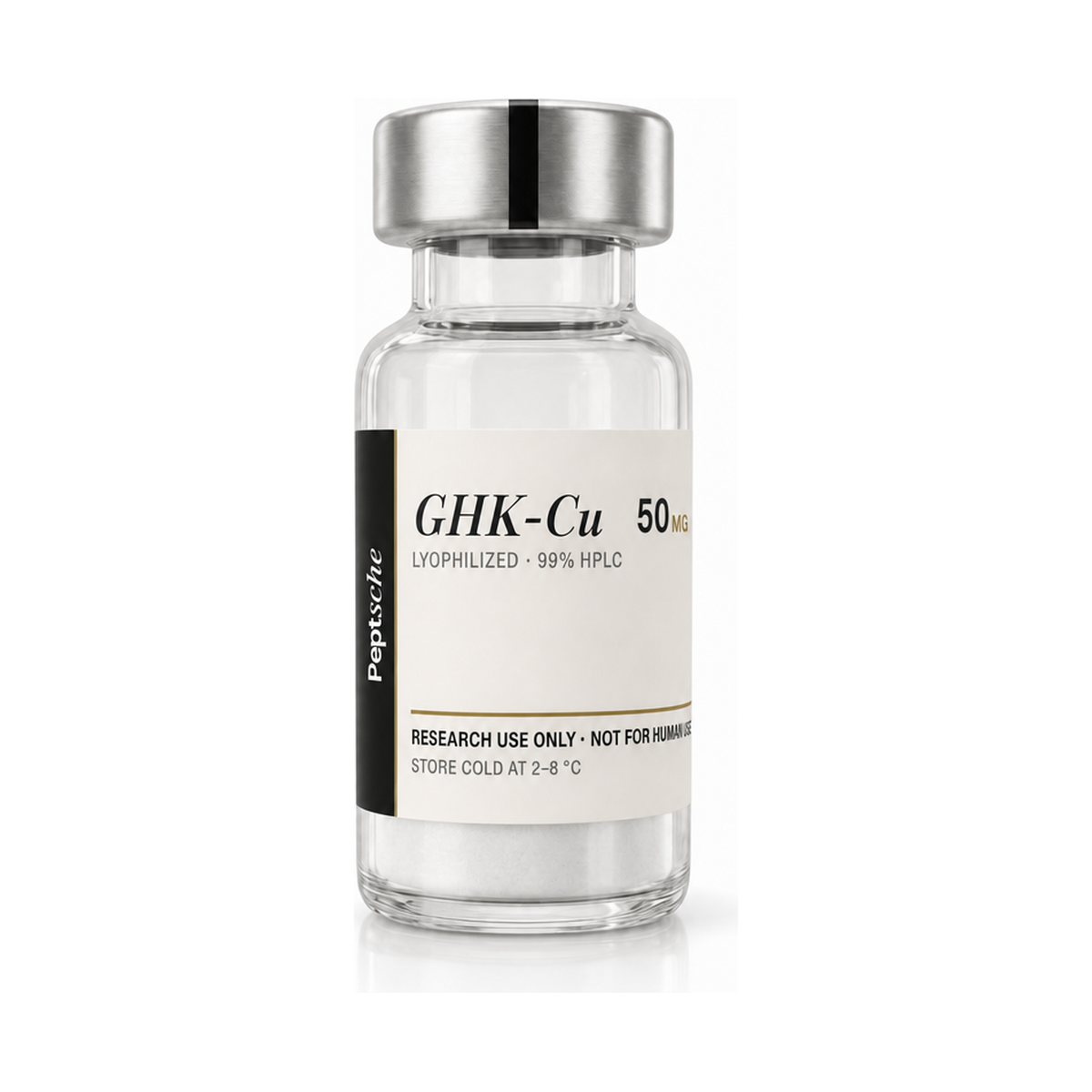
GHK-Cu is a copper complexed tripeptide in which the sequence Gly-His-Lys coordinates one divalent copper ion, giving a defined metallopeptide of formula C14H22N6O4·Cu and molecular weight 401.91 g/mol. Peptsche supplies it as a lyophilized powder sealed in a single use glass vial, a format that keeps the complex stable through transport and cold storage. In the published literature GHK-Cu has been studied in connection with copper ion transport, extracellular matrix biology, gene expression in cultured dermal fibroblasts and tissue remodelling in animal models. Peptsche supplies GHK-Cu strictly as a research material for controlled laboratory investigation.
Available Sizes
This listing covers one vial configuration. Every lot is assayed before release, so the stated purity applies to the batch shipped.
- 50mg vial of lyophilized GHK-Cu, 99% or greater purity by HPLC
Product Specifications
| Product | GHK-Cu (copper tripeptide-1) |
| Application | Research use only. Laboratory and in vitro investigation. |
| Appearance | Blue lyophilized powder |
| Chemical Formula | C14H22N6O4·Cu |
| Molecular Weight | 401.91 g/mol |
| CAS Number | 89030-95-5 |
| PubChem CID | 71587328 |
| Synonyms | Prezatide copper, Copper tripeptide-1, GHK copper, copper peptide |
| Purity | 99% or greater by HPLC, verified per batch |
| Storage | Store sealed at 2 to 8 °C, protected from heat, light and moisture |
| Regulatory Status | Research use compound. Not approved as a drug for human or veterinary use. Used as a cosmetic ingredient under the INCI name Copper tripeptide-1. Injectable GHK-Cu was withdrawn from consideration on the United States Food and Drug Administration bulk drug substances list. |
What is GHK-Cu?
Chemically GHK-Cu belongs to a small family of metal binding peptides. The peptide portion is glycine, histidine and lysine, written Gly-His-Lys, and the histidine imidazole nitrogen together with the terminal amine and the peptide backbone forms a pocket that binds copper with high affinity. The material is a discrete coordination complex with defined stoichiometry rather than a mixture of a peptide and a copper salt, and the blue colour of the powder derives from that copper centre.
Research interest dates to the early 1970s, when the tripeptide was isolated from human plasma during work on serum fractions. Later analysis showed that it associates readily with copper. Through the 1980s and 1990s laboratory groups examined the complex in fibroblast culture and in rodent connective tissue models, while cosmetic science catalogued the same complex under the INCI name Copper tripeptide-1.
The evidence base is preclinical. Published findings come from cell culture, isolated tissue and animal models and describe what was observed in those settings. GHK-Cu is not an approved drug, injectable preparations were withdrawn from consideration on the Food and Drug Administration bulk drug substances list, and no conclusion about humans should be drawn from this record.
GHK-Cu Mechanism of Action (Research Only)
Mechanistic accounts centre on the copper peptide complex rather than on the peptide alone. The summaries below describe reported preclinical observations, not effects in humans.
Copper Ion Coordination and Delivery
The defining property is copper affinity. In experimental systems the tripeptide holds the ion in a stable but exchangeable arrangement, which investigators describe as presenting copper in a chelated rather than a free ionic form. Culture studies have compared the complex against copper salts and against the uncomplexed peptide to separate the contributions of metal centre and peptide scaffold.
Collagen and Extracellular Matrix Gene Expression
Much of the published work examines transcription of matrix associated genes in treated fibroblasts, with reported changes in collagen subtypes, elastin, glycosaminoglycan synthesising enzymes and matrix metalloproteinases with their tissue inhibitors. Maquart and colleagues reported altered connective tissue accumulation in rat experimental models, and genome scale profiling reported by Pickart described coordinated shifts across large numbers of transcripts.
Antioxidant and Tissue Remodelling Signalling
Because copper is a cofactor for superoxide dismutase and other redox active enzymes, mechanistic work has examined the complex in the context of oxidative balance in culture. Reported observations include changes in oxidative stress markers and in the balance between matrix synthesis and matrix degradation in the preparations used.
Integrated Mechanistic Profile
The preclinical literature describes GHK-Cu through three connected themes.
- Copper handling. Reversible coordination that presents copper in a chelated form in the systems studied.
- Matrix gene regulation. Transcriptional shifts in matrix associated genes in cultured fibroblasts and animal tissue.
- Redox and remodelling signalling. Reported changes in oxidative markers and in the balance of matrix synthesis to degradation.
Note: GHK-Cu is supplied strictly for research use only. It is intended as an experimental compound for qualified laboratory personnel and is not a drug, food or cosmetic.
GHK-Cu is supplied exclusively for laboratory research use and is not intended for human or veterinary application.
Research Applications (Observations from Studies)
The areas below describe how GHK-Cu has been used as a research tool and what was reported.
Dermal Fibroblast and Skin Model Systems
Cultured human dermal fibroblasts are the most common system for this compound. Reported endpoints include transcript levels, protein secretion into culture medium and the composition of deposited matrix. Reconstructed skin equivalents and explant preparations have been used in the same way, as laboratory models rather than representations of living subjects.
Connective Tissue Studies in Animal Models
Rodent studies have measured connective tissue accumulation in defined preparations, and in the animal models used investigators reported differences in matrix protein content between treated and untreated groups. Those reports are specific to the species, the model design and the conditions described in each paper.
Copper Biology and Metallopeptide Chemistry
The compound also serves as a reference metallopeptide in coordination chemistry, used to study binding constants, competition with serum copper binding proteins, spectroscopic behaviour and complex stability across buffer conditions.
GHK-Cu is supplied exclusively for laboratory research use and is not intended for human or veterinary application.
GHK-Cu Compared With Related Research Compounds
The table below places GHK-Cu alongside two related compounds in the Peptsche range. It is offered to clarify differences in classification, molecular target and research context. It should not be read as a comparison of clinical performance, safety, or suitability for any application.
| Characteristic | GHK-Cu | Glow Blend | BPC-157 |
| Research Classification | Copper complexed tripeptide, a defined metallopeptide | Three component co lyophilized research blend | Synthetic pentadecapeptide |
| Primary Molecular Target | Copper ion coordination and matrix associated gene transcription | Copper coordination alongside vascular signaling and actin binding targets | Nitric oxide and angiogenic signaling pathways |
| Mechanistic Profile | Reversible copper chelation and matrix gene regulation | Three unrelated pathways, combination not studied in published work | Pleiotropic activity across several signaling systems |
| Primary Research Focus | Dermal fibroblast, connective tissue and copper biology models | Dermal fibroblast, connective tissue and vascular models | Tissue integrity, vascular and mucosal models |
| Structural Design | Gly-His-Lys coordinating one divalent copper ion | Mixture of three materials, no single formula or CAS number | Fifteen residues, no unnatural residues or modification |
| Regulatory Status | Research use compound, not approved as a drug for human or veterinary use, catalogued as a cosmetic ingredient under the INCI name Copper tripeptide-1, with injectable GHK-Cu withdrawn from consideration for compounding by the United States Food and Drug Administration | Research use blend, no component approved as a drug for human or veterinary use, and TB-500 and injectable GHK-Cu both appear on United States Food and Drug Administration listings of substances withdrawn from consideration for compounding | Research use compound, not approved for human or veterinary use |
GHK-Cu is supplied exclusively for laboratory research use and is not intended for human or veterinary application.
Laboratory Handling and Storage Considerations
Lyophilized GHK-Cu should be stored sealed at 2 to 8 °C, protected from heat, light and moisture. The powder is hygroscopic and the copper centre is sensitive to strongly acidic or strongly alkaline conditions and to competing chelators, so vials should reach ambient temperature before opening and buffer choice should account for metal exchange. Prepared solutions should be aliquoted rather than cycled repeatedly through freezing and thawing, and every vial should carry compound identity, lot number and preparation date.
Laboratory Safety Considerations
The practices below apply to routine handling in a research setting.
- Personal protective equipment: Wear nitrile gloves, a laboratory coat and side shield safety glasses whenever a vial is open.
- Engineering controls: Weigh and prepare solutions in a certified fume hood to limit dispersal of the fine powder.
- Exposure prevention: Avoid skin, eye and mucous membrane contact, keep food out of the working area and wash hands afterwards.
- Storage: Keep sealed vials at 2 to 8 °C in a dedicated research chemical location, separated from consumer products.
- Spill response: Collect spilled powder without raising dust, decontaminate the surface and treat the residue as chemical waste.
- Disposal: Discard unused material, solutions and contaminated consumables through the institutional chemical waste stream.
- Documentation: Record lot number, receipt date, storage conditions and each preparation so that results stay traceable to a batch.
Certificate of Analysis and Quality Assurance
Every production lot of GHK-Cu supplied by Peptsche undergoes analytical evaluation, and a batch specific Certificate of Analysis accompanies each order to support research documentation, quality control and experimental consistency.
Each Certificate of Analysis typically includes:
- Identity verification using analytical techniques such as mass spectrometry to confirm the molecular characteristics of the material supplied.
- Purity analysis performed by high performance liquid chromatography to quantify purity and identify potential impurities.
- Batch documentation recording lot number, testing date, analytical methods applied and quality assessment results.
- Traceability information to support laboratory recordkeeping and reproducibility across research workflows.
Peptsche works with Janoshik Analytical, an independent testing laboratory, for third party verification of research material quality. Independent testing provides transparency and confidence in product identity, consistency and sourcing, and batch specific documentation can be retained as part of laboratory records and internal quality procedures.
GHK-Cu is supplied exclusively for laboratory research use and is not intended for human or veterinary application.
Frequently Asked Questions
What is GHK-Cu?
GHK-Cu is a copper complexed tripeptide in which the sequence Gly-His-Lys coordinates one divalent copper ion, forming a discrete coordination complex with defined stoichiometry rather than a mixture of peptide and copper salt. Peptsche supplies it as a blue lyophilized powder sealed in a single use glass vial for controlled laboratory investigation.
What is GHK-Cu studied for in research?
Published investigation is preclinical and spans dermal fibroblast and skin model systems, connective tissue studies in animal models, and copper biology and metallopeptide chemistry. These describe areas of laboratory study rather than established outcomes outside those experimental contexts.
How does GHK-Cu work in laboratory research?
Mechanistic accounts centre on the copper peptide complex rather than the peptide alone. The preclinical literature describes three connected themes: reversible copper coordination that presents the ion in a chelated form, transcriptional shifts in matrix associated genes in cultured fibroblasts and animal tissue, and reported changes in oxidative markers and in the balance of matrix synthesis to degradation.
How is the quality of Peptsche GHK-Cu verified?
Every production lot of Peptsche GHK-Cu is evaluated analytically, with identity confirmed using techniques such as mass spectrometry and purity quantified by high performance liquid chromatography. Peptsche works with Janoshik Analytical, an independent testing laboratory, for third party verification, and a batch specific Certificate of Analysis accompanies each order.
How should unopened GHK-Cu be stored?
Unopened vials should be stored sealed at 2 to 8 °C, protected from heat, light and moisture. Vials should reach ambient temperature before opening, and lot number, storage conditions and preparation date should be recorded in laboratory documentation so results stay traceable to a batch.
Is GHK-Cu intended for human use?
No. GHK-Cu is supplied strictly for laboratory research use only. It is not approved for human consumption, veterinary use, diagnosis, treatment or any medical application.
Why do researchers choose Peptsche for GHK-Cu?
Peptsche supplies GHK-Cu at 99% or greater purity by HPLC, verified per batch, sealed in a single use glass vial with batch specific analytical documentation. Independent third party verification and full lot traceability support reproducibility across research workflows.
Scientific References
- Pickart L, Vasquez-Soltero JM, Margolina A. GHK Peptide as a Natural Modulator of Multiple Cellular Pathways in Skin Regeneration. BioMed Research International. 2015;2015:648108. https://pubmed.ncbi.nlm.nih.gov/26236730/
- Maquart FX, Bellon G, Chaqour B, Wegrowski J, Patt LM, Trachy RE, Monboisse JC, et al. In vivo stimulation of connective tissue accumulation by the tripeptide-copper complex glycyl-L-histidyl-L-lysine-Cu2+ in rat experimental wounds. Journal of Clinical Investigation. 1993;92(5):2368 to 2376. https://pubmed.ncbi.nlm.nih.gov/8227353/
- Pickart L. The human tri-peptide GHK and tissue remodeling. Journal of Biomaterials Science Polymer Edition. 2008;19(8):969 to 988. https://pubmed.ncbi.nlm.nih.gov/18644225/
RESEARCH USE ONLY
These compounds are NOT intended for human consumption, clinical use, or veterinary applications. We are not affiliated with any pharmaceutical companies or their commercial medications. By placing an order, you certify these materials will be used exclusively for in vitro testing and laboratory experimentation only. Bodily introduction of any kind into humans or animals is strictly forbidden by law. This product should only be handled by licensed, qualified professionals. This product is not a drug, food, or cosmetic and may not be misbranded, misused or mislabeled as a drug, food or cosmetic.