

About MOTS-c
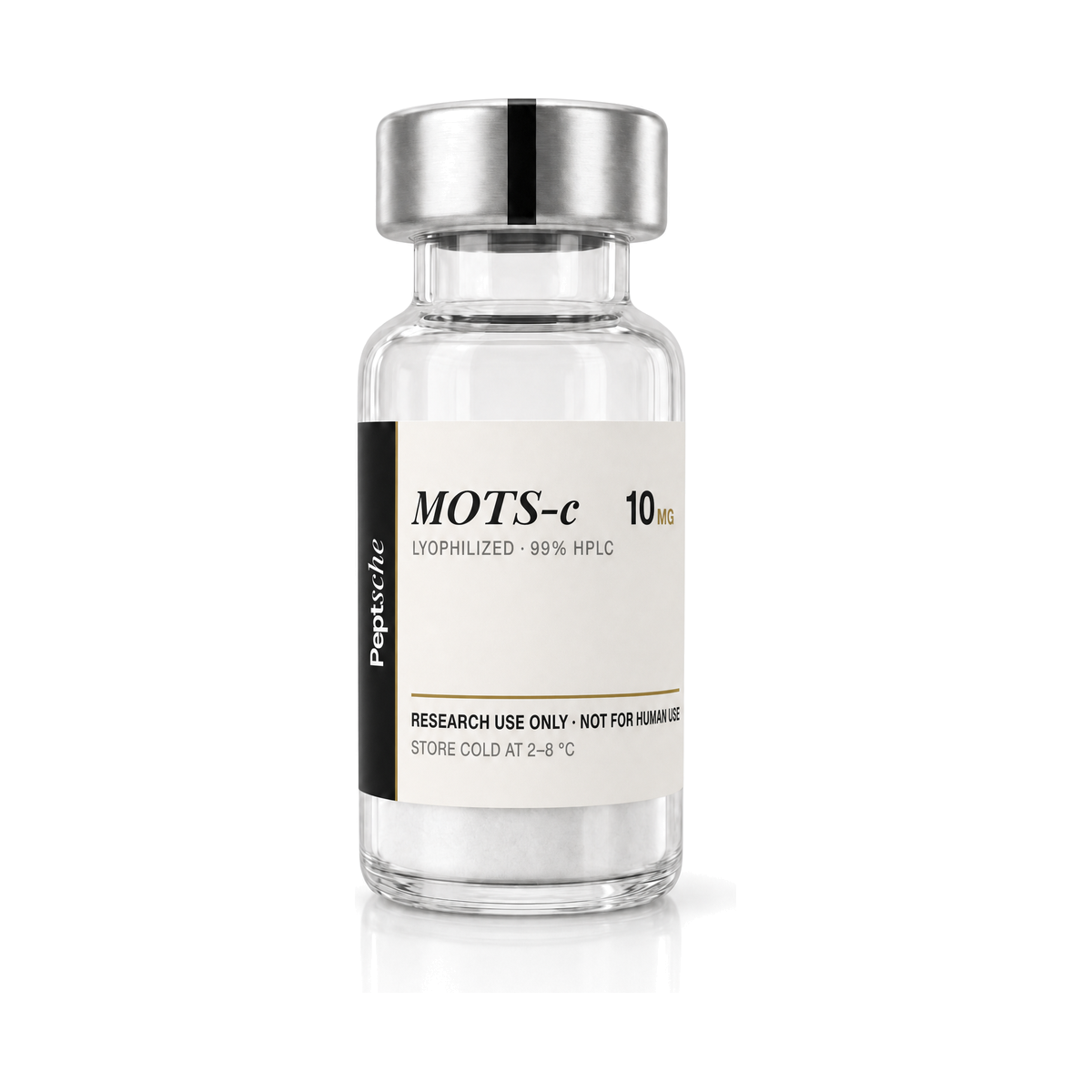
MOTS-c is a sixteen residue peptide encoded not by nuclear DNA but by the mitochondrial genome, within the 12S ribosomal RNA region. Peptides of this class are described in the literature as mitochondrial derived peptides, a group identified only in recent decades and studied for the signalling roles they appear to occupy between the mitochondrion and the rest of the cell. Peptsche supplies it as a lyophilized powder sealed in a single use glass vial, a format stable through transport and cold storage. Peptsche supplies MOTS-c strictly as a research material for controlled laboratory investigation.
Available Sizes
This listing covers a single vial configuration. Every lot is assayed before release, so the stated purity applies to the batch shipped.
- 10mg vial of lyophilized MOTS-c, 99% or greater purity by HPLC
Product Specifications
| Product | MOTS-c (Mitochondrial Open Reading Frame of the 12S rRNA type-c) |
| Application | Research use only. Laboratory and in vitro investigation. |
| Appearance | White to off white lyophilized powder |
| Chemical Formula | C₁₀₂H₁₅₃N₂₅O₂₆S₂ |
| Molecular Weight | approximately 2174 g/mol. No pharmacopoeial monograph exists for this compound, so a precise value to two decimal places is not available from an authoritative source. |
| CAS Number | 1627580-64-6 |
| PubChem CID | 155885767 |
| Sequence | Sixteen residues, one letter MRWQEMGYIFYPRKLR |
| Synonyms | Mitochondrial derived peptide MOTS-c |
| Purity | 99% or greater by HPLC, verified per batch |
| Storage | Store sealed at 2 to 8 °C, protected from heat, light and moisture |
| Regulatory Status | Not approved as a medicine in any jurisdiction. Not approved for human or veterinary use. |
What is MOTS-c?
The defining feature of MOTS-c is its origin. Most peptides studied in a laboratory are transcribed from nuclear genes; this one is read from a short open reading frame inside the mitochondrial 12S ribosomal RNA gene. That placement is what prompted the description of a distinct class of mitochondrial derived peptides, and it is the reason the compound is used as a probe for communication running outward from the mitochondrion rather than inward toward it.
The sequence is short at sixteen residues and carries a net positive charge at physiological pH, a property that features in reported handling behaviour and in discussions of how the peptide distributes in cell culture. It contains two methionine residues, which is relevant to analytical work because methionine is susceptible to oxidation and can complicate chromatographic profiles if material is stored poorly.
The published record consists of cell and animal work conducted by academic groups. Those findings describe the compound as studied under defined laboratory conditions and do not characterise outcomes in humans. Peptsche makes no claim that this compound produces any outcome in a human or animal subject.
MOTS-c Mechanism of Action (Research Only)
Mechanistic interest centres on a metabolic signalling route rather than a classical receptor. The summaries below describe reported cell level observations, not effects in humans.
The Folate Cycle and AICAR Route
Lee and colleagues reported that MOTS-c influences the folate cycle and the purine biosynthesis pathway that runs from it, with accumulation of 5-aminoimidazole-4-carboxamide ribonucleotide, commonly abbreviated AICAR. AICAR is a recognised activator of AMP activated protein kinase, and this indirect route is the mechanism most often cited in the literature. Notably, no cell surface receptor for the peptide has been established.
Nuclear Translocation Under Metabolic Stress
Subsequent work described movement of the peptide into the nucleus under conditions of metabolic stress, where it was reported to associate with stress responsive transcription factors. This observation is what underpins the description of MOTS-c as a retrograde signal, carrying information from the mitochondrion to nuclear gene expression.
An Endogenous Peptide Without an Approved Reference
Because the peptide occurs naturally but has no marketed counterpart, laboratory material cannot be benchmarked against a pharmacopoeial standard. Characterisation rests on the batch certificate of analysis and on published sequence and mass data.
Integrated Mechanistic Profile
The published literature describes MOTS-c through three connected themes.
- Indirect kinase activation. Folate cycle interference leading to AICAR accumulation and downstream AMP activated protein kinase activity.
- Retrograde signalling. Reported nuclear translocation under metabolic stress and association with stress responsive transcription factors.
- Mitochondrial origin. Encoded within the mitochondrial 12S ribosomal RNA gene rather than by nuclear DNA.
Note: MOTS-c is supplied strictly for research use only. It is intended as an experimental compound for qualified laboratory personnel and is not a drug, food or cosmetic.
MOTS-c is supplied exclusively for laboratory research use and is not intended for human or veterinary application.
Research Applications (Observations from Studies)
The areas below describe reported research uses.
Cellular Metabolism Assays
The characteristic experiment measures glucose uptake, oxygen consumption rate or extracellular acidification in cultured myotubes or hepatocytes, with phosphorylation state of AMP activated protein kinase read by immunoblot as a companion endpoint.
Mitochondrial Derived Peptide Comparison
The compound is frequently placed alongside humanin and the SHLP family to ask how members of this class differ within one assay system. Observations from that work belong to the systems and conditions described in each publication.
Analytical Method Development
Laboratories building chromatographic or mass spectrometric methods for short cationic peptides use material of this kind to establish retention and fragmentation behaviour. The two methionine residues make it a useful test case for oxidation monitoring during method validation.
MOTS-c is supplied exclusively for laboratory research use and is not intended for human or veterinary application.
MOTS-c Compared With Related Research Compounds
The table below places MOTS-c alongside two related compounds in the Peptsche range. It is offered to clarify differences in classification, molecular target and research context. It should not be read as a comparison of clinical performance, safety, or suitability for any application.
| Characteristic | MOTS-c | NAD+ | SS-31 |
| Research Classification | Sixteen residue mitochondrial derived peptide encoded in the 12S ribosomal RNA gene | Dinucleotide coenzyme, not a peptide | Synthetic tetrapeptide with alternating aromatic and basic residues |
| Primary Molecular Target | No established cell surface receptor. Acts indirectly through the folate cycle and AICAR accumulation | Acts as a redox cofactor and substrate for sirtuins and PARP enzymes | Associates with cardiolipin in the inner mitochondrial membrane |
| Mechanistic Profile | Indirect AMP activated protein kinase activation, with reported nuclear translocation under metabolic stress | Participates directly in electron transfer and in enzymatic reactions consuming the dinucleotide | Reported to influence cristae architecture and electron transport efficiency through a lipid interaction rather than a receptor |
| Primary Research Focus | Cellular metabolism assays, mitochondrial derived peptide comparison, analytical method development | Redox biology, sirtuin enzymology, cofactor availability studies | Mitochondrial bioenergetics and membrane biophysics |
| Regulatory Status | Not approved as a medicine in any jurisdiction and not approved for human or veterinary use | Not approved as a medicine in any jurisdiction and not approved for human or veterinary use | Investigational compound. Not approved as a medicine in any jurisdiction and not approved for human or veterinary use |
MOTS-c is supplied exclusively for laboratory research use and is not intended for human or veterinary application.
Laboratory Handling and Storage Considerations
Lyophilized MOTS-c should be stored sealed at 2 to 8 °C, protected from heat, light and moisture. The powder is hygroscopic, so vials should reach ambient temperature before opening to prevent condensation onto the cake. The sequence carries two methionine residues that are susceptible to oxidation, so prolonged exposure to air and light should be avoided and solutions should be prepared fresh where the protocol allows. The peptide is cationic and can adsorb to glass and plastic, so low binding labware is commonly selected. Prepared solutions should be aliquoted rather than cycled through freezing and thawing, and every container should carry identity, lot number and preparation date.
Laboratory Safety Considerations
The practices below apply to routine handling in a research setting.
- Personal protective equipment: Wear nitrile gloves, a laboratory coat and safety glasses whenever a vial is open.
- Engineering controls: Weigh and prepare solutions in a certified fume hood to limit powder dispersal.
- Exposure prevention: Avoid skin, eye and mucous membrane contact and wash hands afterwards.
- Storage: Keep sealed vials at 2 to 8 °C in a dedicated research chemical location.
- Spill response: Collect spilled powder without raising dust and treat residue as chemical waste.
- Disposal: Discard unused material and contaminated consumables through the institutional chemical waste stream.
- Documentation: Record lot number, receipt date and each preparation so results stay traceable to a batch.
Certificate of Analysis and Quality Assurance
Every production lot of MOTS-c supplied by Peptsche undergoes analytical evaluation, and a batch specific Certificate of Analysis accompanies each order to support research documentation, quality control and experimental consistency.
Each Certificate of Analysis typically includes:
- Identity verification using analytical techniques such as mass spectrometry to confirm the molecular characteristics of the material supplied.
- Purity analysis performed by high performance liquid chromatography to quantify purity and identify potential impurities.
- Batch documentation recording lot number, testing date, analytical methods applied and quality assessment results.
- Traceability information to support laboratory recordkeeping and reproducibility across research workflows.
Peptsche works with Janoshik Analytical, an independent testing laboratory, for third party verification of research material quality. Independent testing provides transparency and confidence in product identity, consistency and sourcing, and batch specific documentation can be retained as part of laboratory records and internal quality procedures.
MOTS-c is supplied exclusively for laboratory research use and is not intended for human or veterinary application.
Frequently Asked Questions
What is MOTS-c?
MOTS-c is a sixteen residue peptide encoded within the mitochondrial 12S ribosomal RNA gene rather than by nuclear DNA, placing it in the class described as mitochondrial derived peptides. It is not approved as a medicine in any jurisdiction and is not approved for human or veterinary use. Peptsche supplies it as a lyophilized powder sealed in a single use glass vial for controlled laboratory investigation.
What is MOTS-c studied for in research?
Published laboratory work covers cellular metabolism assays measuring glucose uptake and oxygen consumption in cultured myotubes and hepatocytes, comparison against other mitochondrial derived peptides such as humanin, and analytical method development for short cationic peptides. These describe areas of laboratory study rather than established outcomes outside those experimental systems.
How does MOTS-c work in laboratory research?
In the systems described in the literature the peptide influences the folate cycle and the purine biosynthesis pathway running from it, with accumulation of AICAR, a recognised activator of AMP activated protein kinase. No cell surface receptor has been established, so the route is described as indirect. Separate work reported movement of the peptide into the nucleus under metabolic stress and association with stress responsive transcription factors.
How is the quality of Peptsche MOTS-c verified?
Every production lot of Peptsche MOTS-c is evaluated analytically, with identity confirmed using techniques such as mass spectrometry and purity quantified by high performance liquid chromatography against the stated specification of 99% or greater. Peptsche works with Janoshik Analytical, an independent testing laboratory, for third party verification, and a batch specific Certificate of Analysis accompanies each order.
How should unopened MOTS-c be stored?
Unopened vials should be stored sealed at 2 to 8 °C, protected from heat, light and moisture. Vials should reach ambient temperature before opening so condensation does not form on the cold powder. Because the sequence contains two oxidation sensitive methionine residues, exposure to air and light should be kept brief. Lot number, receipt date and storage conditions should be recorded in laboratory documentation so results stay traceable to a batch.
Is MOTS-c intended for human use?
No. MOTS-c is supplied strictly for laboratory research use only. It is not approved for human consumption, veterinary use, diagnosis, treatment or any medical application.
Why do researchers choose Peptsche for MOTS-c?
Peptsche supplies MOTS-c at 99% or greater purity by HPLC, verified per batch, as a lyophilized powder sealed in a single use glass vial that stays stable through transport and cold storage. Because no pharmacopoeial monograph exists for this compound, batch specific analytical documentation and independent third party confirmatory analysis are what support reproducibility across research workflows.
Scientific References
- Lee C, Zeng J, Drew BG, Sallam T, Martin-Montalvo A, Wan J, Kim SJ, Mehta H, et al. The mitochondrial-derived peptide MOTS-c promotes metabolic homeostasis and reduces obesity and insulin resistance. Cell Metabolism. 2015;21(3):443 to 454. https://pubmed.ncbi.nlm.nih.gov/25738459/
- Kim KH, Son JM, Benayoun BA, Lee C. The Mitochondrial-Encoded Peptide MOTS-c Translocates to the Nucleus to Regulate Nuclear Gene Expression in Response to Metabolic Stress. Cell Metabolism. 2018;28(3):516 to 524. https://pubmed.ncbi.nlm.nih.gov/29983246/
- Merry TL, Chan A, Woodhead JST, Reynolds JC, Kumagai H, Kim SJ, Lee C. Mitochondrial-derived peptides in energy metabolism. American Journal of Physiology, Endocrinology and Metabolism. 2020;319(4):E659 to E666. https://pubmed.ncbi.nlm.nih.gov/32776825/
RESEARCH USE ONLY
These compounds are NOT intended for human consumption, clinical use, or veterinary applications. We are not affiliated with any pharmaceutical companies or their commercial medications. By placing an order, you certify these materials will be used exclusively for in vitro testing and laboratory experimentation only. Bodily introduction of any kind into humans or animals is strictly forbidden by law. This product should only be handled by licensed, qualified professionals. This product is not a drug, food, or cosmetic and may not be misbranded, misused or mislabeled as a drug, food or cosmetic.