

About Tesamorelin
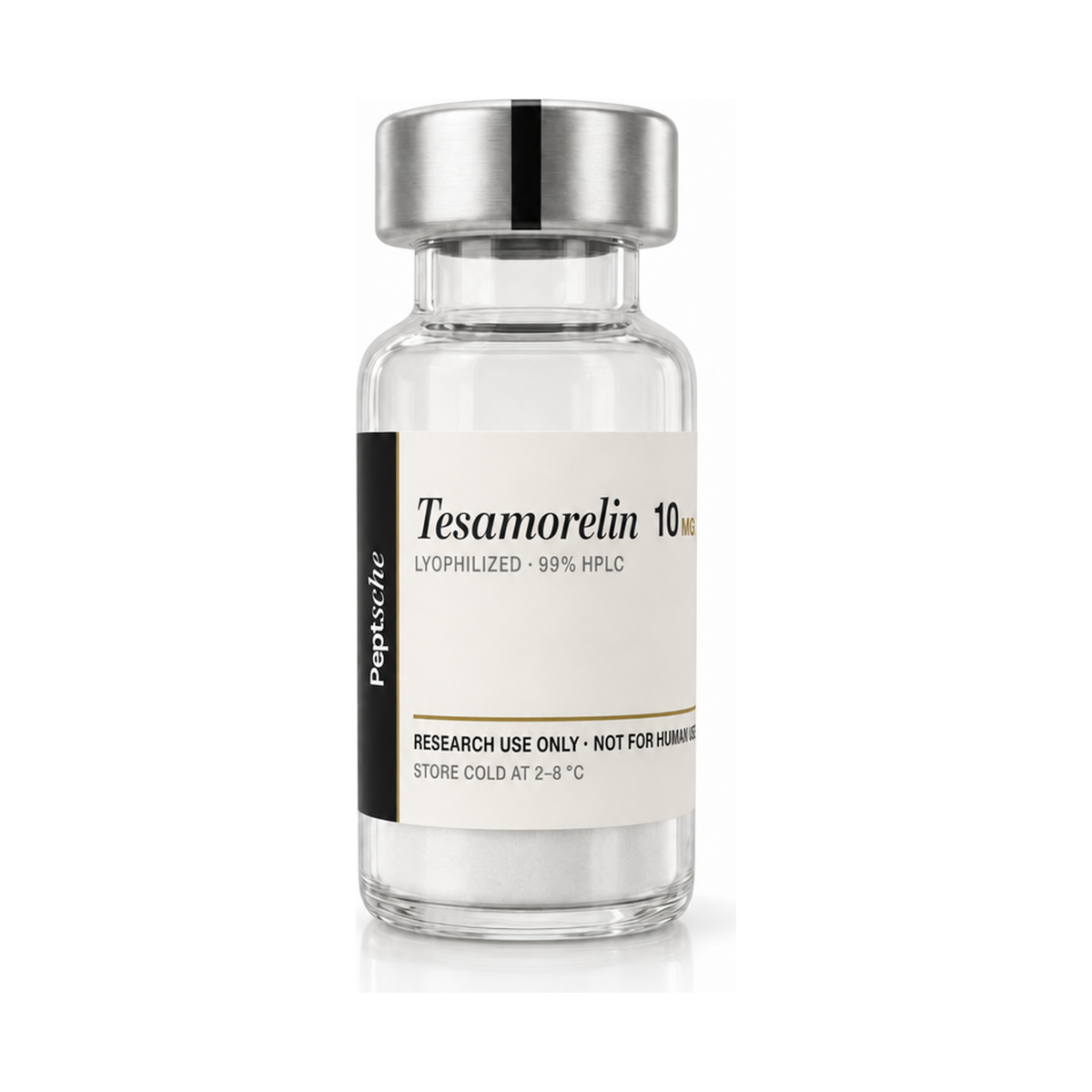
Tesamorelin is a synthetic 44 residue analogue of human growth hormone releasing hormone, distinguished from the native peptide by a trans 3 hexenoyl group at the amino terminus. Peptsche offers it as a lyophilized powder in a sealed vial, prepared by solid phase synthesis and characterised by chromatography and mass spectrometry. Because the same molecule is also the active ingredient of an approved prescription medicine, the distinction between that product and this laboratory reagent is set out plainly below. Peptsche supplies Tesamorelin strictly as a research material for controlled laboratory investigation.
Available Sizes
Offered in one vial configuration, sealed with a butyl closure and crimp.
- 10 mg lyophilized Tesamorelin per vial
Product Specifications
| Product | Tesamorelin, research grade lyophilized powder |
| Application | In vitro and laboratory research use only. Not for human or veterinary use. |
| Appearance | White to off white powder |
| Chemical Formula | C221H366N72O67S |
| Molecular Weight | 5135.9 g/mol |
| CAS Number | 218949-48-5 (acetate salt 804475-66-9) |
| PubChem CID | 16137828 |
| Sequence | A 44 residue growth hormone releasing hormone analogue, N terminally acylated with trans 3 hexenoyl. One letter code YADAIFTNSYRKVLGQLSARKLLQDIMSRQQGESNQERGARARL with a C terminal amide. |
| Synonyms | TH9507, hexenoyl somatoliberin, GHRH(1-44) analogue |
| Purity | 99% or greater by HPLC, verified per batch |
| Storage | Store sealed at 2 to 8 °C, protected from heat, light and moisture |
| Regulatory Status | The tesamorelin molecule is the active ingredient in an approved prescription medicine marketed as Egrifta by Theratechnologies, approved by the United States Food and Drug Administration in 2010. The material supplied by Peptsche is a research grade compound. It is not that approved medicine, is not manufactured to pharmaceutical standards, and is not approved for human or veterinary use. |
What is Tesamorelin?
Growth hormone releasing hormone, also called somatoliberin, is a 44 residue hypothalamic peptide acting on somatotroph cells of the anterior pituitary. Tesamorelin retains the complete sequence rather than the truncated fragment used in many analogues, and adds a six carbon unsaturated acyl group at the amino terminus.
That acyl modification is the defining chemical feature. It sits at the position most vulnerable to aminopeptidase attack and alters the conformation of the amino terminus, the region responsible for activation. The result is a ligand that keeps agonist character while resisting the rapid trimming that limits the native hormone as a laboratory tool.
The regulatory distinction should stay clear. The same molecule is manufactured under pharmaceutical controls by its developer and sold as an approved prescription product. The material offered here is a research reagent. It shares the chemical structure but not the manufacturing controls, formulation, excipients or regulatory status of that medicine, and clinical data on the medicine does not characterise this reagent.
Tesamorelin Mechanism of Action (Research Only)
Mechanistic interest centres on one receptor system and on how the acyl modification and chain length alter ligand behaviour.
Growth Hormone Releasing Hormone Receptor Agonism
Tesamorelin binds the growth hormone releasing hormone receptor on anterior pituitary somatotrophs. That class B G protein coupled receptor signals mainly through the stimulatory G protein, raising cyclic adenosine monophosphate and activating protein kinase A. Standard cell based readouts are cyclic nucleotide accumulation and secretory output from pituitary cultures, with the amino terminal region serving as the activating element.
The Hexenoyl Modification and Stability
The trans 3 hexenoyl group shields the first residues from aminopeptidase and dipeptidyl peptidase activity, the pathways that clear the native hormone quickly from serum. The hydrophobic acyl chain also influences aggregation and solubility, which matters when preparing reference solutions. The practical consequence is a longer usable measurement window in matrices where the unmodified hormone would already have degraded.
Full Length 44 Residue Structure
Most analogues in this family are built on the first 29 residues, the minimal fragment retaining receptor activity. Tesamorelin instead carries the complete 44 residue chain with a carboxyl terminal amide. That extra region adds helical stability and binding surface, making the molecule a useful comparator for laboratories asking what residues beyond position 29 contribute to affinity and conformation.
Integrated Mechanistic Profile
- Receptor engagement: agonism at the growth hormone releasing hormone receptor of the anterior pituitary.
- Acyl modification: the trans 3 hexenoyl group confers resistance to peptidase trimming.
- Full length scaffold: the complete 44 residue chain distinguishes it from shorter analogues.
Note: Tesamorelin is supplied strictly for research use only. It is intended as an experimental compound for qualified laboratory personnel and is not a drug, food or cosmetic.
Tesamorelin is supplied exclusively for laboratory research use and is not intended for human or veterinary application.
Research Applications (Observations from Studies)
The summaries below describe published work involving this molecule. They are not statements about the product offered for sale.
Clinical Studies of the Approved Medicine
The three references below are human clinical trials of the approved pharmaceutical product, conducted and sponsored by its developer and collaborators. They evaluated a manufactured medicine under regulated conditions. Their findings characterise that medicine and its formulation. They do not characterise research grade material and must not be read as describing the compound sold here.
Receptor and Analytical Characterisation
Separately, laboratories use analogues of this class in receptor expressing systems and in analytical method development, where a ligand of known purity supports calibration and evaluation of assay cross reactivity.
Comparative Structural Work
The full length acylated structure makes this a natural comparator against shorter analogues of the same family, in studies of how chain length and amino terminal modification affect stability.
Tesamorelin is supplied exclusively for laboratory research use and is not intended for human or veterinary application.
Tesamorelin Compared With Related Research Compounds
The table below places Tesamorelin alongside two related compounds in the Peptsche range. It is offered to clarify differences in classification, molecular target and research context. It should not be read as a comparison of clinical performance, safety, or suitability for any application.
| Characteristic | Tesamorelin | Sermorelin | CJC-1295 |
| Research Classification | Synthetic 44 residue analogue of human growth hormone releasing hormone | Synthetic 29 residue fragment of human growth hormone releasing hormone | Synthetic 29 residue analogue of growth hormone releasing factor |
| Primary Molecular Target | Growth hormone releasing hormone receptor on pituitary somatotrophs | Growth hormone releasing hormone receptor on pituitary somatotrophs | Growth hormone releasing factor receptor on pituitary somatotrophs |
| Mechanistic Profile | Agonism at the growth hormone releasing hormone receptor, with an acyl group resisting peptidase trimming | Agonism at the growth hormone releasing hormone receptor, unmodified parent scaffold | Agonism at the growth hormone releasing hormone receptor, with a brief plasma profile |
| Primary Research Focus | Comparative structural work, receptor and analytical characterisation | Reference comparator in analogue design, peptide modification chemistry, endocrine signalling models | Receptor pharmacology, comparative stability and analytical method development |
| Structural Design | Full 44 residue chain, trans 3 hexenoyl group at the amino terminus, terminal amide | Residues 1 to 29 with a terminal amide, one methionine, no unnatural residues | 29 residues with four substitutions, no albumin binding moiety |
| Regulatory Status | The molecule is the active ingredient in an approved medicine marketed as Egrifta by Theratechnologies. Material supplied is research grade, is not that medicine, and is not approved for human or veterinary use | Formerly the active ingredient in an approved medicine marketed as Geref by EMD Serono, with all products under those applications now discontinued. Material supplied is research grade, is not that former medicine, and is not approved for human or veterinary use | Research use compound, not approved for human or veterinary use in any jurisdiction, and withdrawn from consideration on the United States Food and Drug Administration bulk drug substances list |
Tesamorelin is supplied exclusively for laboratory research use and is not intended for human or veterinary application.
Laboratory Handling and Storage Considerations
This is a large peptide with a hydrophobic amino terminal group, and the lyophilized powder is hygroscopic. Vials should reach ambient temperature before opening so condensation does not form on the cold cake. Sealed vials are stable at 2 to 8 °C when kept dry and dark.
In solution stability falls sharply and aggregation is a real concern for a molecule of this size carrying an acyl chain. Solutions should be sterile filtered, buffered, refrigerated, protected from light and used within a window the laboratory sets by its own testing. Aliquot into single use portions, and prefer glass or low binding polypropylene labware because adsorption losses are significant.
Laboratory Safety Considerations
- Personal protective equipment: laboratory coat, nitrile gloves and eye protection whenever the vial is open.
- Engineering controls: handle open vials inside a certified fume hood or containment enclosure.
- Exposure prevention: avoid contact with skin and eyes, do not inhale the powder, never pipette by mouth.
- Storage: keep sealed at 2 to 8 °C, protected from heat, light and moisture, in a restricted area.
- Spill response: restrict access, avoid raising dust, collect with a damp wipe, then decontaminate and seal the waste.
- Disposal: treat unused material and contaminated consumables as chemical laboratory waste under institutional rules.
- Documentation: record lot number, receipt date, storage conditions and quantities used for traceability.
Certificate of Analysis and Quality Assurance
Every production lot of Tesamorelin supplied by Peptsche undergoes analytical evaluation, and a batch specific Certificate of Analysis accompanies each order to support research documentation, quality control and experimental consistency.
Each Certificate of Analysis typically includes:
- Identity verification using analytical techniques such as mass spectrometry to confirm the molecular characteristics of the material supplied.
- Purity analysis performed by high performance liquid chromatography to quantify purity and identify potential impurities.
- Batch documentation recording lot number, testing date, analytical methods applied and quality assessment results.
- Traceability information to support laboratory recordkeeping and reproducibility across research workflows.
Peptsche works with Janoshik Analytical, an independent testing laboratory, for third party verification of research material quality. Independent testing provides transparency and confidence in product identity, consistency and sourcing, and batch specific documentation can be retained as part of laboratory records and internal quality procedures.
Tesamorelin is supplied exclusively for laboratory research use and is not intended for human or veterinary application.
Frequently Asked Questions
What is Tesamorelin?
Tesamorelin is a synthetic 44 residue analogue of human growth hormone releasing hormone, distinguished from the native peptide by a trans 3 hexenoyl group at the amino terminus. The same molecule is the active ingredient in an approved prescription medicine marketed as Egrifta by Theratechnologies. The material supplied by Peptsche is a research grade compound, is not that approved medicine, is not manufactured to pharmaceutical standards, and is not approved for human or veterinary use.
What is Tesamorelin studied for in research?
Laboratories use analogues of this class in receptor expressing systems and in analytical method development, where a ligand of known purity supports calibration and evaluation of assay cross reactivity. The full length acylated structure also makes the molecule a comparator against shorter analogues in studies of how chain length and amino terminal modification affect stability. The clinical trials cited on this page evaluated the approved medicine and its formulation and do not characterise research grade material.
How does Tesamorelin work in laboratory research?
Tesamorelin binds the growth hormone releasing hormone receptor on anterior pituitary somatotrophs, a class B G protein coupled receptor signalling mainly through the stimulatory G protein. The trans 3 hexenoyl group shields the first residues from aminopeptidase and dipeptidyl peptidase activity, giving a longer usable measurement window in matrices where the unmodified hormone would already have degraded. The complete 44 residue chain adds helical stability and binding surface relative to shorter analogues.
How is the quality of Peptsche Tesamorelin verified?
Every production lot of Peptsche Tesamorelin is evaluated analytically, with identity confirmed using techniques such as mass spectrometry and purity quantified by high performance liquid chromatography. Peptsche works with Janoshik Analytical, an independent testing laboratory, for third party verification, and a batch specific Certificate of Analysis accompanies each order.
How should unopened Tesamorelin be stored?
Unopened vials should be stored sealed at 2 to 8 °C, protected from heat, light and moisture. Vials should reach ambient temperature before opening so condensation does not form on the cold powder. Lot number, receipt date and storage conditions should be recorded in laboratory documentation so results stay traceable to a batch.
Is Tesamorelin intended for human use?
No. Tesamorelin is supplied strictly for laboratory research use only. It is not approved for human consumption, veterinary use, diagnosis, treatment or any medical application.
Why do researchers choose Peptsche for Tesamorelin?
Peptsche supplies Tesamorelin at 99% or greater purity by HPLC, verified per batch, as a lyophilized powder in a vial sealed with a butyl closure and crimp. Each lot is released against batch specific analytical documentation, and independent third party confirmatory analysis supports reproducibility across research workflows.
Scientific References
- Falutz J, Allas S, Blot K, Potvin D, Kotler D, Somero M, Berger D, Brown S, et al. Metabolic effects of a growth hormone-releasing factor in patients with HIV. New England Journal of Medicine. 2007;357(23):2359 to 2370. https://pubmed.ncbi.nlm.nih.gov/18057338/
- Falutz J, Mamputu JC, Potvin D, Moyle G, Soulban G, Loughrey H, Marsolais C, Turner R, Grinspoon S. Effects of tesamorelin (TH9507), a growth hormone-releasing factor analog, in human immunodeficiency virus-infected patients with excess abdominal fat. Journal of Clinical Endocrinology and Metabolism. 2010;95(9):4291 to 4304. https://pubmed.ncbi.nlm.nih.gov/20554713/
- Stanley TL, Falutz J, Marsolais C, Morin J, Soulban G, Mamputu JC, Assaad H, Turner R, Grinspoon SK. Reduction in visceral adiposity is associated with an improved metabolic profile in HIV-infected patients receiving tesamorelin. Clinical Infectious Diseases. 2012;54(11):1642 to 1651. https://pubmed.ncbi.nlm.nih.gov/22495074/
RESEARCH USE ONLY
These compounds are NOT intended for human consumption, clinical use, or veterinary applications. We are not affiliated with any pharmaceutical companies or their commercial medications. By placing an order, you certify these materials will be used exclusively for in vitro testing and laboratory experimentation only. Bodily introduction of any kind into humans or animals is strictly forbidden by law. This product should only be handled by licensed, qualified professionals. This product is not a drug, food, or cosmetic and may not be misbranded, misused or mislabeled as a drug, food or cosmetic.