

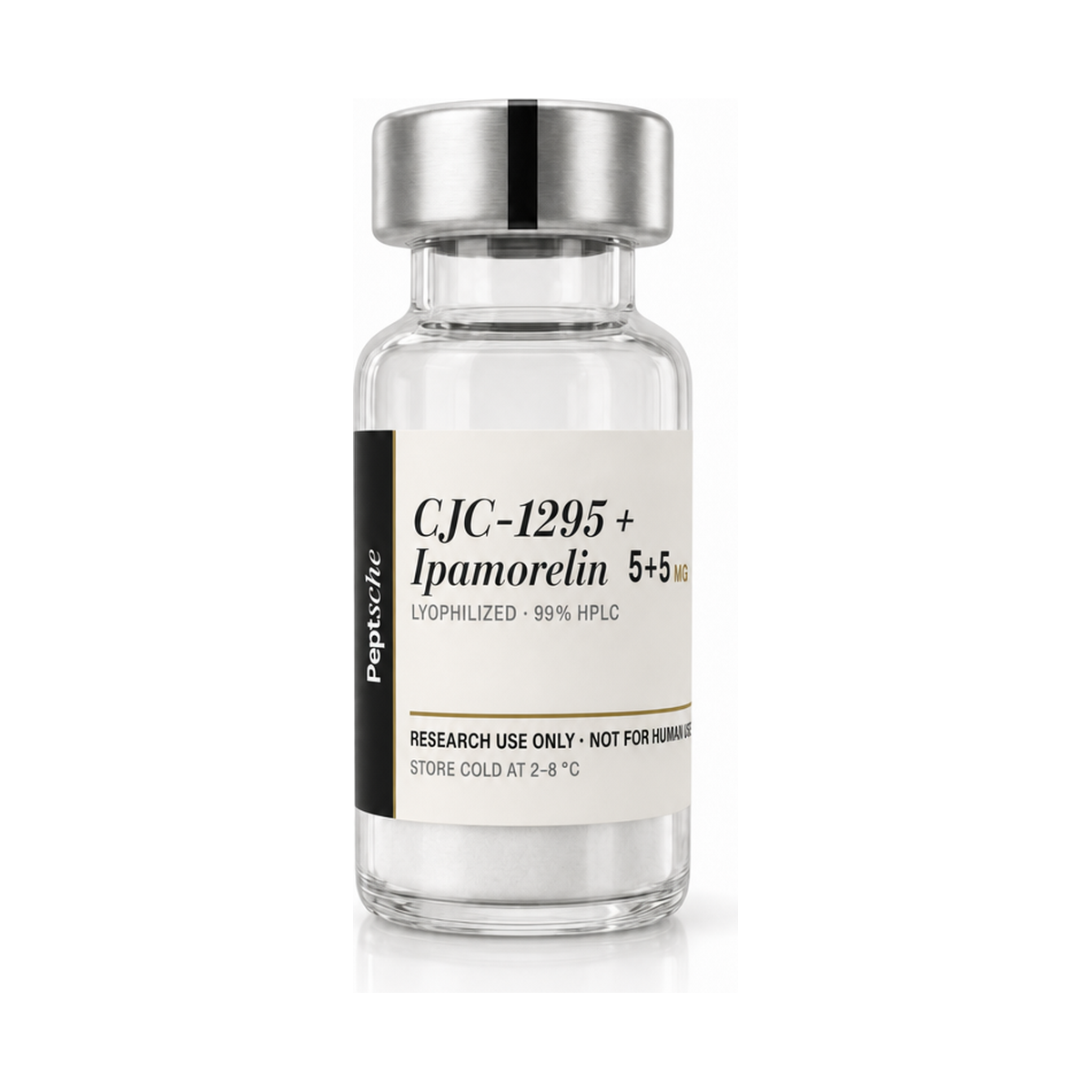
About CJC-1295 + Ipamorelin
This is a combination vial holding two synthetic peptides co lyophilized together: CJC-1295 without DAC, a 29 residue analogue of growth hormone releasing factor, and Ipamorelin, a pentapeptide secretagogue acting at a separate receptor. Both are supplied as a single powder cake, so laboratories studying the two receptor pathways receive them in a fixed documented ratio. Each component is synthesised and characterised separately before blending. Peptsche supplies CJC-1295 + Ipamorelin strictly as a research material for controlled laboratory investigation.
Available Sizes
Offered in one combination vial, sealed with a butyl closure and crimp.
- 5 mg CJC-1295 without DAC and 5 mg Ipamorelin, co lyophilized in one vial
Product Specifications
| Product | CJC-1295 without DAC and Ipamorelin blend, research grade lyophilized powder |
| Application | In vitro and laboratory research use only. Not for human or veterinary use. |
| Appearance | White to off white powder |
| Composition | CJC-1295 without DAC 5 mg and Ipamorelin 5 mg, co lyophilized in a single vial |
| Chemical Formula (CJC-1295) | C152H252N44O42 |
| Molecular Weight (CJC-1295) | 3367.9 g/mol |
| CAS Number (CJC-1295) | Pending verification. Public chemical registries currently disagree on the assignment for the form without DAC, so Peptsche does not publish a CAS number for this product. |
| PubChem CID (CJC-1295) | 56841945 |
| Sequence (CJC-1295) | Tyr D-Ala Asp Ala Ile Phe Thr Gln Ser Tyr Arg Lys Val Leu Ala Gln Leu Ser Ala Arg Lys Leu Leu Gln Asp Ile Leu Ser Arg NH2 |
| Chemical Formula (Ipamorelin) | C38H49N9O5 |
| Molecular Weight (Ipamorelin) | 711.9 g/mol |
| CAS Number (Ipamorelin) | 170851-70-4 |
| PubChem CID (Ipamorelin) | 9831659 |
| Sequence (Ipamorelin) | Aib His D-2-Nal D-Phe Lys NH2 |
| Synonyms | CJC-1295 no DAC and Ipamorelin blend, GHRH and GHRP combination vial |
| Purity | 99% or greater by HPLC, verified per batch |
| Storage | Store sealed at 2 to 8 °C, protected from heat, light and moisture |
| Regulatory Status | Research use blend. Neither component is approved for human or veterinary use in any jurisdiction. Both CJC-1295 and ipamorelin appear on United States Food and Drug Administration bulk drug substances listings as substances withdrawn from consideration or presenting potential safety risks. |
What is CJC-1295 + Ipamorelin?
The two molecules belong to different chemical and pharmacological classes. CJC-1295 without DAC reproduces the active amino terminal fragment of hypothalamic growth hormone releasing factor, modified at four positions to resist cleavage. Ipamorelin is a synthetic pentapeptide of unnatural residues, designed as a selective ligand at the ghrelin receptor rather than as an analogue of an endogenous peptide.
Presenting both in one vial is a convenience for laboratories exposing a preparation to two ligands at a fixed ratio without weighing each separately. Because the components are co lyophilized the ratio cannot be varied, trading flexibility for consistency between experiments.
Published work on this combination is sparser than the literature on either molecule alone. The references below characterise the individual components. No cited study examined the two together as a blend, so inferences about combined behaviour are extrapolation rather than observation.
CJC-1295 + Ipamorelin Mechanism of Action (Research Only)
Interest in this preparation rests on two components engaging separate receptors that converge on one pituitary cell type.
Growth Hormone Releasing Factor Receptor Pathway
The CJC-1295 component binds the growth hormone releasing factor receptor on anterior pituitary somatotrophs, a class B G protein coupled receptor signalling through the stimulatory G protein and raising cyclic adenosine monophosphate. Four substitutions limit cleavage by dipeptidyl peptidase, so the ligand persists longer in serum than the native fragment.
Ghrelin Receptor GHS-R1a Pathway
Ipamorelin binds the growth hormone secretagogue receptor GHS-R1a, a class A receptor coupling to the Gq protein and mobilising intracellular calcium through phospholipase C. Its selectivity is what made it notable in the original characterisation: it engages this receptor without the cross reactivity of earlier secretagogues in the same family.
Rationale for Combined Study Designs
Because the two receptors act through different second messenger systems in the same cell, investigators have used ligand pairs of this kind to ask whether responses are additive, synergistic or mutually limiting. A blend gives a fixed ratio starting point. The confounder is unequal persistence of the components, so occupancy at the two sites does not track together over a time course.
Integrated Mechanistic Profile
- Two receptor pathways: growth hormone releasing factor receptor agonism alongside ghrelin receptor GHS-R1a agonism.
- Distinct signalling: cyclic nucleotide signalling from one component, calcium mobilisation from the other.
- Limited combination data: published evidence on the blend is sparser than on either component alone.
Note: CJC-1295 + Ipamorelin is supplied strictly for research use only. It is intended as an experimental compound for qualified laboratory personnel and is not a drug, food or cosmetic.
CJC-1295 + Ipamorelin is supplied exclusively for laboratory research use and is not intended for human or veterinary application.
Research Applications (Observations from Studies)
The summaries below describe published research on the individual components. They are not statements about the blend offered for sale.
Receptor Selectivity Characterisation
The original description of Ipamorelin established it as a selective secretagogue receptor ligand in preclinical models, distinguishing it from earlier compounds in the same chemical series.
Preclinical Model Work
Later work examined the pentapeptide in rodent models to characterise skeletal endpoints, a reference point for laboratories designing comparable studies.
Comparative Ligand Studies
The growth hormone releasing factor analogue has been characterised in receptor expressing systems, giving binding and signalling parameters against which blend behaviour can be assessed.
CJC-1295 + Ipamorelin is supplied exclusively for laboratory research use and is not intended for human or veterinary application.
CJC-1295 + Ipamorelin Compared With Related Research Compounds
The table below places CJC-1295 + Ipamorelin alongside two related compounds in the Peptsche range. It is offered to clarify differences in classification, molecular target and research context. It should not be read as a comparison of clinical performance, safety, or suitability for any application.
| Characteristic | CJC-1295 + Ipamorelin | CJC-1295 | Ipamorelin |
| Research Classification | Two component co lyophilized research blend | Synthetic 29 residue analogue of growth hormone releasing factor | Synthetic pentapeptide growth hormone secretagogue |
| Primary Molecular Target | Growth hormone releasing factor receptor and ghrelin receptor GHS-R1a | Growth hormone releasing factor receptor on pituitary somatotrophs | Ghrelin receptor GHS-R1a on pituitary somatotrophs |
| Mechanistic Profile | Both receptor systems engaged together, cyclic nucleotide signalling alongside calcium mobilisation | Agonism at the growth hormone releasing hormone receptor, with a brief plasma profile | Agonism at the ghrelin receptor GHS-R1a, a receptor system separate from the growth hormone releasing hormone receptor |
| Primary Research Focus | Combined ligand study designs across two receptor pathways | Receptor pharmacology, comparative stability and analytical method development | Pituitary cell and receptor assays, rodent skeletal endpoints, comparative secretagogue pharmacology |
| Structural Design | Two peptides in one vial at a fixed ratio, no single formula or CAS number | 29 residues with four substitutions, no albumin binding moiety | Five residues including non standard Aib and D configured aromatic residues, amidated terminus |
| Regulatory Status | Research use blend, neither component approved for human or veterinary use in any jurisdiction, and both components appear on United States Food and Drug Administration bulk drug substances listings | Research use compound, not approved for human or veterinary use in any jurisdiction, and withdrawn from consideration on the United States Food and Drug Administration bulk drug substances list | Research use compound, not approved for human or veterinary use in any jurisdiction, and placed in Category 2 of the United States Food and Drug Administration list of bulk drug substances |
CJC-1295 + Ipamorelin is supplied exclusively for laboratory research use and is not intended for human or veterinary application.
Laboratory Handling and Storage Considerations
A co lyophilized blend behaves as one powder cake but contains two molecules of different physical properties, so partial withdrawal cannot be assumed to preserve the stated ratio. Treat the vial as a single unit and take it fully into solution before use. Sealed vials are stable at 2 to 8 °C when kept dry and dark, and should reach ambient temperature before opening so condensation does not form.
In solution both components degrade faster than in the dry state, and the two do not degrade at the same rate. Solutions should be sterile filtered, refrigerated, protected from light and used within a window the laboratory sets by its own testing. Aliquot into single use portions.
Laboratory Safety Considerations
- Personal protective equipment: laboratory coat, nitrile gloves and eye protection whenever the vial is open.
- Engineering controls: handle open vials inside a certified fume hood or containment enclosure.
- Exposure prevention: avoid contact with skin and eyes, do not inhale the powder, never pipette by mouth.
- Storage: keep sealed at 2 to 8 °C, protected from heat, light and moisture, in a restricted area.
- Spill response: restrict access, avoid raising dust, collect with a damp wipe, then decontaminate and seal the waste.
- Disposal: treat unused material and contaminated consumables as chemical laboratory waste under institutional rules.
- Documentation: record lot number, receipt date, storage conditions and quantities used for traceability.
Certificate of Analysis and Quality Assurance
Every production lot of CJC-1295 + Ipamorelin supplied by Peptsche undergoes analytical evaluation, and a batch specific Certificate of Analysis accompanies each order to support research documentation, quality control and experimental consistency.
Each Certificate of Analysis typically includes:
- Identity verification using analytical techniques such as mass spectrometry to confirm the molecular characteristics of the material supplied.
- Purity analysis performed by high performance liquid chromatography to quantify purity and identify potential impurities.
- Batch documentation recording lot number, testing date, analytical methods applied and quality assessment results.
- Traceability information to support laboratory recordkeeping and reproducibility across research workflows.
Peptsche works with Janoshik Analytical, an independent testing laboratory, for third party verification of research material quality. Independent testing provides transparency and confidence in product identity, consistency and sourcing, and batch specific documentation can be retained as part of laboratory records and internal quality procedures.
CJC-1295 + Ipamorelin is supplied exclusively for laboratory research use and is not intended for human or veterinary application.
Frequently Asked Questions
What is CJC-1295 + Ipamorelin?
CJC-1295 + Ipamorelin is a combination vial holding two synthetic peptides co lyophilized together: CJC-1295 without DAC, a 29 residue analogue of growth hormone releasing factor, and Ipamorelin, a pentapeptide secretagogue acting at a separate receptor. Each component is synthesised and characterised separately before blending. The two are supplied as a single powder cake in a fixed documented ratio.
What is CJC-1295 + Ipamorelin studied for in research?
Published work on this combination is sparser than the literature on either molecule alone, and the cited references characterise the individual components. Those cover receptor selectivity characterisation, preclinical model work and comparative ligand studies. No cited study examined the two together as a blend, so inferences about combined behaviour are extrapolation rather than observation.
How does CJC-1295 + Ipamorelin work in laboratory research?
The CJC-1295 component binds the growth hormone releasing factor receptor on anterior pituitary somatotrophs, a class B G protein coupled receptor raising cyclic adenosine monophosphate. The Ipamorelin component binds the ghrelin receptor GHS-R1a, a class A receptor mobilising intracellular calcium through phospholipase C. Investigators have used ligand pairs of this kind to ask whether responses in a given preparation are additive, synergistic or mutually limiting.
How is the quality of Peptsche CJC-1295 + Ipamorelin verified?
Every production lot of Peptsche CJC-1295 + Ipamorelin is evaluated analytically, with identity confirmed using techniques such as mass spectrometry and purity quantified by high performance liquid chromatography. Peptsche works with Janoshik Analytical, an independent testing laboratory, for third party verification, and a batch specific Certificate of Analysis accompanies each order.
How should unopened CJC-1295 + Ipamorelin be stored?
Unopened vials should be stored sealed at 2 to 8 °C, protected from heat, light and moisture. Vials should reach ambient temperature before opening so condensation does not form on the cold powder. Lot number, receipt date and storage conditions should be recorded in laboratory documentation so results stay traceable to a batch.
Is CJC-1295 + Ipamorelin intended for human use?
No. CJC-1295 + Ipamorelin is supplied strictly for laboratory research use only. It is not approved for human consumption, veterinary use, diagnosis, treatment or any medical application.
Why do researchers choose Peptsche for CJC-1295 + Ipamorelin?
Peptsche supplies this blend at 99% or greater purity by HPLC, verified per batch, with each component synthesised and characterised separately before blending. Certificates report identity of both components and confirmation of the stated ratio, and independent third party confirmatory analysis supports reproducibility across research workflows.
Scientific References
- Jetté L, Léger R, Thibaudeau K, Benquet C, Robitaille M, Pellerin I, Paradis V, van Wyk P, et al. Human growth hormone-releasing factor (hGRF)1-29-albumin bioconjugates activate the GRF receptor on the anterior pituitary in rats: identification of CJC-1295 as a long-lasting GRF analog. Endocrinology. 2005;146(7):3052 to 3058. https://pubmed.ncbi.nlm.nih.gov/15817669/
- Raun K, Hansen BS, Johansen NL, Thøgersen H, Madsen K, Ankersen M, Andersen PH. Ipamorelin, the first selective growth hormone secretagogue. European Journal of Endocrinology. 1998;139(5):552 to 561. https://pubmed.ncbi.nlm.nih.gov/9849822/
- Johansen PB, Nowak J, Skjaerbaek C, Flyvbjerg A, Andreassen TT, Wilken M, Orskov H. Ipamorelin, a new growth-hormone-releasing peptide, induces longitudinal bone growth in rats. Growth Hormone and IGF Research. 1999;9(2):106 to 113. https://pubmed.ncbi.nlm.nih.gov/10373343/
RESEARCH USE ONLY
These compounds are NOT intended for human consumption, clinical use, or veterinary applications. We are not affiliated with any pharmaceutical companies or their commercial medications. By placing an order, you certify these materials will be used exclusively for in vitro testing and laboratory experimentation only. Bodily introduction of any kind into humans or animals is strictly forbidden by law. This product should only be handled by licensed, qualified professionals. This product is not a drug, food, or cosmetic and may not be misbranded, misused or mislabeled as a drug, food or cosmetic.